

Powerlifting for Rehab in Speonk, NY
Squat, bench and deadlift used as the rehabilitation itself. Scaled correctly, the three lifts build bone, restore confidence in a joint, and hold function in neurological conditions better than machines do.
The barbell is not the reward at the end of rehab. It can be the rehab.
Rehab has a habit of ending too early and too light. You get out of pain, you finish a program of bands and bodyweight work, and you are discharged at a level of strength that would not survive a real week. Then a stair, a suitcase or a grandchild finds the gap.
Powerlifting-style loading closes it. The squat, the bench press and the deadlift are not exotic gym lifts, they are the three things a body has to do: stand up, push, and pick something up. Scaled correctly they become precise rehabilitation tools. A box squat is a graded knee and hip rehab exercise. A floor press or an incline press is a shoulder progression with a measurable load. A trap bar deadlift or a rack pull is back and posterior chain rehab you can put a number on, which is what lets us prove you are stronger rather than ask you how it feels.
This matters most for the people usually told to avoid weight. Bone responds to load, so osteoporosis and low bone density are a reason to lift, coached, not a reason to stop. Chronic pain and fear of movement respond to graded exposure, and a barbell gives us the smallest possible increments to expose you with. And in Parkinson’s and other neurological conditions, heavy, deliberate, whole-body effort preserves the force production that keeps someone independent. That work runs alongside our neurological rehab and the boxing classes.
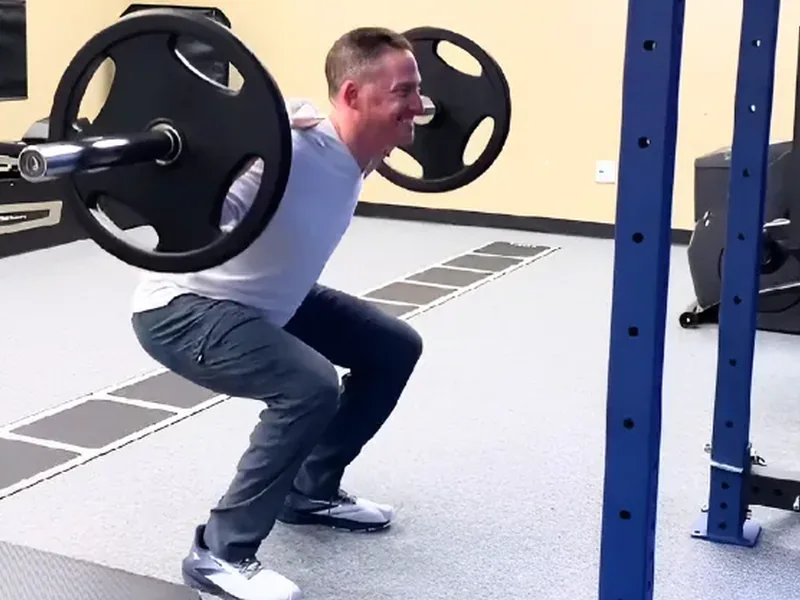
Who we load this way.
Not just lifters. In fact, mostly not lifters.
Parkinson’s and neuro patients
Modified barbell work to preserve strength, power and function, coached and scaled at every session.
Osteoporosis and low bone density
Bone adapts to load. Supervised, progressive lifting is the intervention, and it needs to be taught properly.
Post-surgical patients
Knee and hip replacements, ACL and rotator cuff repairs, taken further than a standard discharge takes them.
Chronic pain and fear of movement
Graded exposure with a barbell, in the smallest increments available, until the movement stops being frightening.
Older adults
Getting off the floor, carrying groceries, climbing stairs. All strength problems, all trainable at any age.
Experienced lifters
Competitive and recreational powerlifters who want technical coaching and a plan that works around an injury.
What you get out of it.
Strength you can measure, in the movements life actually uses.
Load your bones respond to
Progressive, supervised loading, which is the stimulus bone density work actually requires.
Posterior chain strength
Hips, glutes and back trained hard, which is where posture, balance and getting off the floor all come from.
Numbers instead of feelings
A load on the bar is objective. You can see progress, and so can your physician.
Confidence in the movement
Graded exposure ends the fear of bending, lifting and loading, which for many chronic pain patients is the real limitation.
Function held in neuro conditions
Deliberate, whole-body force production, which is what independence in Parkinson’s and similar conditions depends on.
Technique that keeps you safe
Coaching on setup, bracing and bar path from staff who treat lifting injuries for a living.
Questions about powerlifting for rehab.
01 / Is powerlifting safe for rehab, or for someone my age?
02 / Do I need a referral, and how does insurance work?
03 / Do I need lifting experience?
04 / How is this different from your weightlifting rehab page?
What our patients say.
"I had a personal experience working with expert therapists there after undergoing two knee replacements. The one-on-one attention I received was second to none."Greiner patient · Two knee replacements
Schedule Your Appointment
No referral needed in New York. Same-week appointments available at both locations.
Your first visit is a full one-on-one evaluation with a licensed physical therapist: come in, tell us everything, and leave with a plan.
You’re all set.
We’ll reach out within one business day to confirm your appointment. If you need to speak with us sooner, call us directly.