

Spinal Mobilization in Speonk, NY
Sustained, gentle oscillation kept inside the range your joint already has. No thrust, which is why it suits an irritable back and a spine with low bone density.
Slow, graded, and inside the range the joint already gives.
Spinal mobilization is non-thrust manual therapy. Your therapist applies rhythmic, sustained pressure to a spinal segment and works it through small oscillations, staying inside the range that segment already has. Nothing is taken past end range and there is no pop. The grade of pressure gets dialled up or down according to how irritable the tissue is that day.
It is the same target as manipulation, reached differently. Both are aimed at a segment that has stopped gliding. Manipulation gets there with one fast, small thrust. Mobilization gets there over repeated slow passes, which lets your therapist read your response continuously and stop the instant the tissue objects.
That control is the whole reason this page exists. If your back is acutely irritable, if you have osteoporosis or low bone density, if you are early after spine surgery, or if the idea of being thrusted makes you tense up before the hands even land, mobilization is the technique that fits. A guarded patient cannot be treated well, and mobilization does not ask you to relax on command.
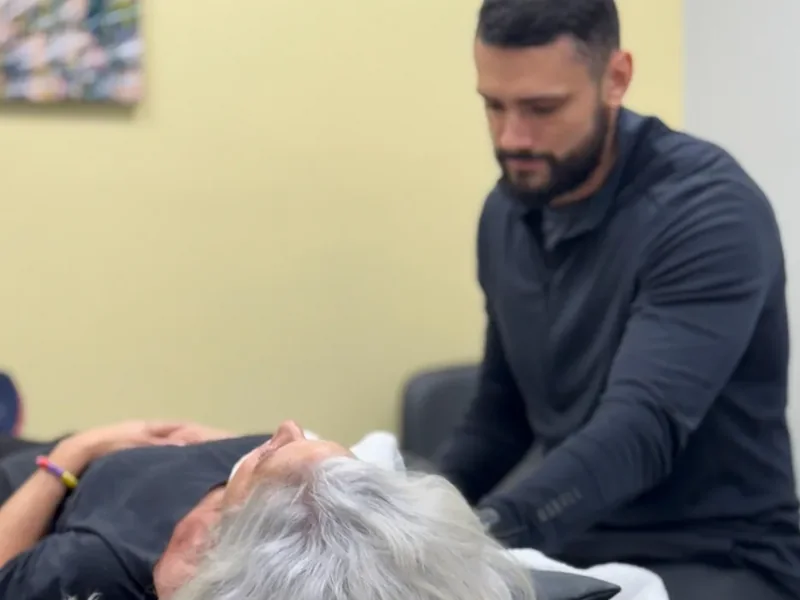
Who mobilization is for.
These are the cases where a thrust is either unwise or unnecessary.
Acute, Irritable Back Pain
A back angry enough that end-range anything sets it off for the next two days.
Osteoporosis & Low Bone Density
Spines where the right technique is the one that never loads end range at speed.
Early After Spine Surgery
Patients cleared for hands-on work but not for a thrust, rebuilding motion around a fusion or a decompression.
Arthritic, Age-Related Spines
Stiffness spread across many levels rather than locked at one, which responds better to repeated gentle input.
Necks That Will Not Let Go
Guarded necks and upper backs where the muscles fire before the technique has even started.
Anyone Who Would Rather Not Be Thrusted
A completely reasonable preference. It changes the technique, not the outcome we are working toward.
What you should notice.
Progress without paying for it the next morning.
Relief Without A Flare
Change that does not cost you two bad days afterward.
Motion Back In Stages
Range returns in increments you can feel between visits.
A Technique That Fits Your Bones
A spine with low density gets treated rather than avoided.
Less Guarding
Muscles that have been protecting the segment start letting go, which makes the rest of the plan work.
Questions about spinal mobilization.
01 / What is the difference between mobilization and manipulation?
02 / Which one do I need?
03 / Will one session fix it?
04 / Do I need a referral, and how does the insurance work?
What our patients say.
"I recently had a life changing accident resulting in a serious spine injury. Post operative care and therapy has been amazing. Great Dr's and staff."Eric T. · Spine injury recovery
Schedule Your Appointment
No referral needed in New York. Same-week appointments available at both locations.
Your first visit is a full one-on-one evaluation with a licensed physical therapist: come in, tell us everything, and leave with a plan.
You’re all set.
We’ll reach out within one business day to confirm your appointment. If you need to speak with us sooner, call us directly.