

Hip & Knee Pain Treatment in Speonk, NY
Stairs, hills and getting out of a low chair have all become decisions. Before anyone talks about surgery, there is usually a great deal that strength and hands-on care can change.
The hip and the knee share the load, and they share the blame. The spot that hurts is often not the spot that failed.
These two joints work as a pair. The hip sets the position of the thigh and the knee lives with the consequences, which is why a hip that has lost rotation or an abductor group that has gone weak so often shows up as knee pain on stairs. It runs the other way too. A knee that will not fully straighten changes how you walk, and the hip pays for it. Pain can also refer: an irritated hip joint commonly sends pain down the front of the thigh toward the knee, and people arrive convinced the knee is the problem.
Then there is the load itself. Every step you take goes through these joints. If the muscles around them are not carrying their share, the joint surfaces, the bursae and the tendons absorb more of it, thousands of times a day. That is the mechanism behind most of the hip and knee pain we see: arthritis, bursitis, tendon pain around the hip, kneecap pain, and the aching that starts an hour into a walk.
Which is also why so much of it responds to therapy. The joint changes on an X-ray do not reverse. How the joint gets loaded, how much strength surrounds it and how efficiently you walk are all very much in play, and those three things determine most of what you feel.
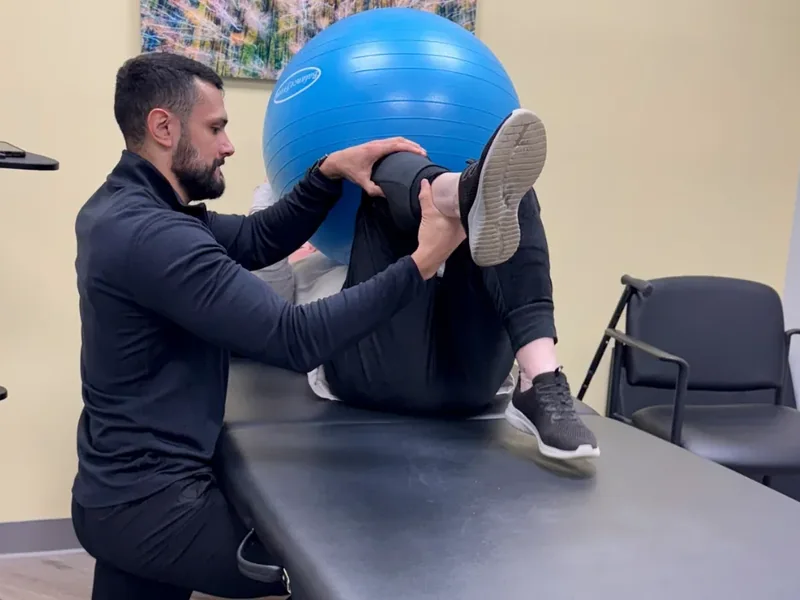
The patterns worth getting evaluated.
What provokes it and when it hurts tells us which of the two joints is actually driving it.
Stairs, hills and low chairs
Going down stairs hurts most, and getting out of a low seat has become something you plan for.
Night pain lying on your side
Classic for the outside of the hip, and it is usually tendon or bursa rather than the joint itself.
Pain in the front of the thigh or the knee
Groin or thigh pain reaching toward the knee, which often means the hip joint is the source.
A limp, or a leg you favour
You shorten the step, lead with the good leg, and lean on the rail without thinking about it.
The leg feels like it could let go
Buckling or a lack of confidence stepping down, which is strength and control rather than instability of the joint.
Swelling and stiffness after activity
The joint puffs and tightens the day after a long walk, a round of golf or an afternoon in the garden.
How we treat hip and knee pain without surgery.
The evaluation is the part that gets skipped elsewhere and it is where this page begins. We test both joints, not just the sore one. We watch you walk, squat, step down and rise from a chair. We measure strength and range side to side, palpate the tendons and bursae, and screen your low back, because it refers into both. By the end you know which structure is producing your pain and which limitation is feeding it.
Your plan is then built to do specific things: reduce pain in the irritated tissue by hand, restore the hip and knee motion you have lost, rebuild the glute, quadriceps, hamstring and calf strength that takes load off the joint, retrain how you walk and step so the load stops landing in the same place, restore your confidence on stairs and uneven ground, and get you back to a specific activity you can name.
The tools are manual therapy and joint mobilization, Active Release Technique for tissue that is bound down, progressive strengthening, blood flow restriction training where a joint will not yet tolerate heavier loads, gait and step retraining, and a short home program in the app. Imaging is often not required to start, and if we find something that needs an X-ray or a surgical opinion, we say so early rather than treating you for months.
No referral needed in New York for up to 30 days or 10 visits. In network with Medicare and Medicare Advantage, out of network with most other plans, and we submit claims on your behalf. Same-week appointments are usually available at both locations.
Questions about hip and knee pain.
01 / My hip hurts but the pain runs down to my knee. What is going on?
02 / Do I need an X-ray or MRI before physical therapy?
03 / Should I keep walking or rest it?
04 / What does it cost and does insurance apply?
What our patients say.
"Eamon was great! My knee pain is totally gone!!"Mindy Z. · Knee pain
Schedule Your Appointment
No referral needed in New York. Same-week appointments available at both locations.
Your first visit is a full one-on-one evaluation with a licensed physical therapist: come in, tell us everything, and leave with a plan.
You’re all set.
We’ll reach out within one business day to confirm your appointment. If you need to speak with us sooner, call us directly.