

Shoulder Pain Treatment in Speonk, NY
It hurts to reach the top shelf, it wakes you when you roll on to it, and nobody has told you why. The first job is not treatment. It is finding out which structure is actually complaining.
The shoulder gave up stability to buy range. That is the whole story.
No other joint in the body moves as freely, and it manages that by sitting a large ball on a small, shallow socket held in place almost entirely by muscle. It is a remarkable design and a demanding one. Everything depends on the rotator cuff and the muscles around the shoulder blade doing precise work at the right moment, and when their capacity falls behind what you are asking, the joint starts compressing tissue it should be gliding past.
That is why so much shoulder pain has no injury attached to it. Nothing tore. The demand crept up, or the capacity crept down, and the margin closed. It also explains the mismatch patients find so confusing: the same shoulder can feel almost normal at waist height and vicious overhead, because position changes how much the cuff has to control.
And it is why guessing wastes months. Cuff-related pain, bursitis, a stiffening joint capsule, a biceps tendon, arthritis and pain referred from the neck can all present as an ache on the outside of the shoulder, and the correct treatment for one is the wrong treatment for another. Testing sorts them out. A generic shoulder exercise sheet does not.
What your shoulder is telling us.
The details you might dismiss are usually the ones that identify the structure.
Pain in an arc, not everywhere
A specific band of the lift that hurts, with the range above and below it comparatively comfortable.
It wakes you up
Night pain and being unable to sleep on that side is one of the most common reasons people finally call.
Stiffness in every direction
Loss of motion actively and passively, especially reaching out and rotating, which points at the joint capsule.
Weakness or a dead arm feeling
The arm gives way holding something out in front of you, which is a strength finding worth testing properly.
Pain, numbness or tingling down the arm
Symptoms travelling past the elbow suggest the neck or a nerve is involved rather than the shoulder alone.
It started after a fall
Trauma, sudden loss of ability to lift the arm, deformity or heavy bruising need an examination promptly.
Diagnose first, treat by hand, then build capacity that holds.
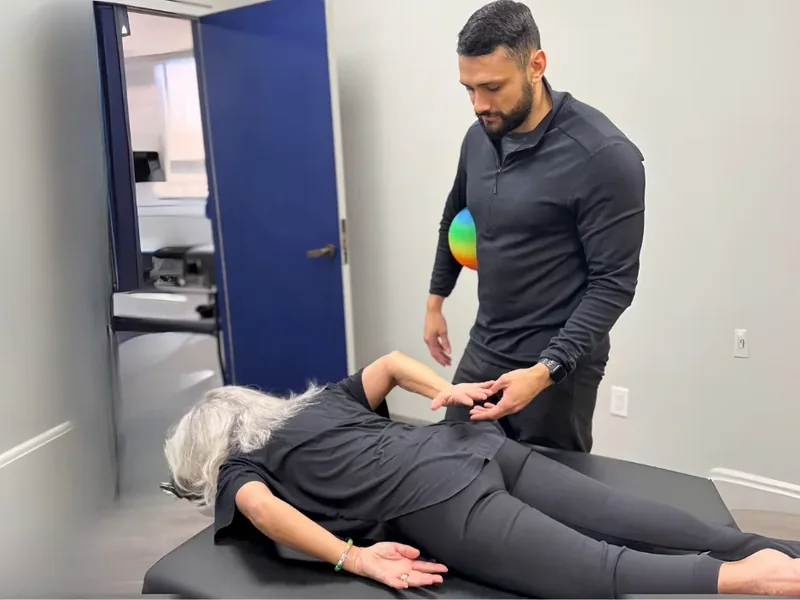
Your first visit is an examination, not a modality. Motion measured actively and passively, strength tested by direction, the shoulder blade watched while you move, the neck and thoracic spine screened because they contribute more often than people expect, and your specific painful tasks reproduced so we know what we are treating. By the end you should be able to explain your own shoulder in a sentence.
Treatment follows the finding. Manual therapy and joint mobilisation for a stiff capsule or a restricted thoracic spine, soft tissue work for the tissue that has been guarding, and then progressive loading of the cuff and scapular muscles through ranges we expand as they earn it. Where posture and a rigid mid-back are keeping the joint in a bad position, we address that directly rather than telling you to sit up straight. Every visit is one on one with a licensed physical therapist, which is what makes correcting these movements in real time possible.
No referral needed in New York for up to 30 days or 10 visits. In network with Medicare and Medicare Advantage, out of network with most other plans, and we submit claims on your behalf. Same-week appointments are usually available at both locations.
Questions about shoulder pain.
01 / Do I need an MRI or a referral before starting physical therapy?
02 / What about insurance?
03 / Should I rest my shoulder or keep using it?
04 / How long before this improves?
What our patients say.
"Over the years I have gone for Physical Therapy in many places for many reasons. Griener Physical Therapy was out of doubt one of the best experiences. I was lucky enough to have."Sandi N. · Google review
Schedule Your Appointment
No referral needed in New York. Same-week appointments available at both locations.
Your first visit is a full one-on-one evaluation with a licensed physical therapist: come in, tell us everything, and leave with a plan.
You’re all set.
We’ll reach out within one business day to confirm your appointment. If you need to speak with us sooner, call us directly.