

Rock Steady Boxing in the Hamptons
Rock Steady Boxing is a national noncontact boxing program for people with Parkinson’s. We are the Hampton Bays affiliate, and Seth Greiner, PT, MSPT is the head coach.
A national program for Parkinson’s, run here by a physical therapist.
Rock Steady Boxing is a noncontact boxing program designed specifically for people with Parkinson’s disease. It started in Indianapolis and has spread to affiliates around the country, each led by coaches trained in the method. The premise is simple and well supported: Parkinson’s takes away big, fast, powerful movement, so the training should be big, fast and powerful, and it should ask more of you than a gentle mobility class does.
We are the Hampton Bays affiliate. Seth Greiner, PT, MSPT is the head coach, and he earned his certification at the original Rock Steady Boxing affiliate in Indianapolis. He has been coaching noncontact boxing with the Stony Brook Southampton Hospital Center for Parkinson’s Disease for more than three years. Because he is a licensed physical therapist, the class is built and progressed the way clinical care is, and it sits alongside the one-on-one neurological work we do at the clinic rather than replacing it.
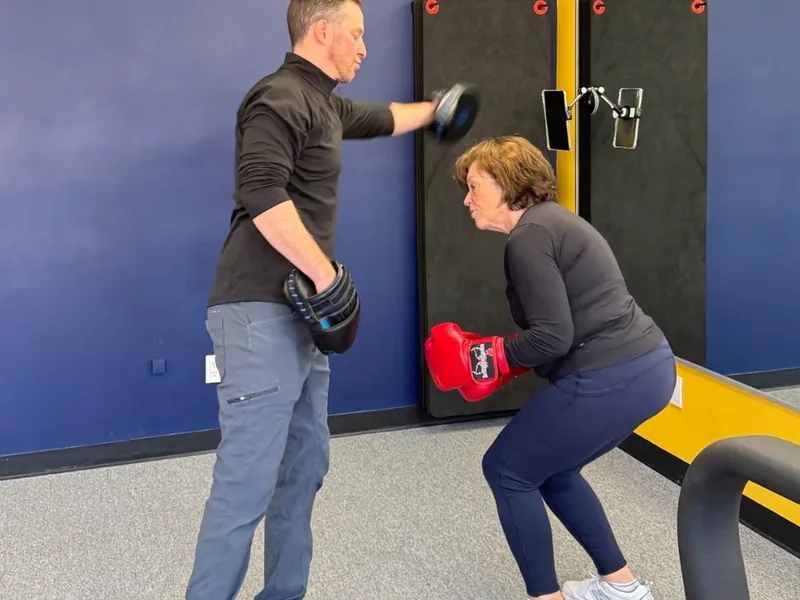
Nothing in this program involves getting hit. You punch bags and mitts. There is no sparring, no partner contact, and no experience required. The only thing that carries over from real boxing is the work.
Who can join.
People diagnosed with Parkinson’s, at any stage and any fitness level.
Any stage of Parkinson’s
From newly diagnosed to years in. Drills are scaled to what you can do today, including from a chair.
Any fitness background
Former athletes and people who have never exercised in a group train in the same room, at different intensities.
No boxing experience
Nobody arrives knowing how to throw a jab. Learning it is part of the cognitive load, and that is deliberate.
People who cannot travel in
A remote class runs on Zoom with the same structure, for anyone who cannot get to Speonk.
Why noncontact boxing works for Parkinson’s.
Five reasons, each of them something the diagnosis takes and the training gives back.
Power
Punching is fast force production. That is the exact quality Parkinson’s erodes and the exact quality a stumble recovery needs.
Rotation
Every punch turns the trunk on the hips. Rotation is one of the first things to go and one of the easiest to train back.
Balance
Footwork, stance changes and reaction drills are done standing, in every class, with a coach in reach.
Voice
We use our voices out loud on purpose, because volume fades with Parkinson’s and it responds to being used.
Community
A room of people with the same diagnosis, working hard, is the strongest argument against isolation we have found.
Cognitive challenge
Combinations have to be remembered and sequenced under fatigue, which makes the class a thinking task as much as a physical one.
Questions about rock steady boxing.
01 / When are classes, and what do they cost?
02 / How is this different from your Parkinson’s boxing page?
03 / Do I need a referral, or physical therapy first?
04 / Will I get hit?
What our patients say.
"The physical therapists at Greiner are the best I have ever worked with. I feel extremely fortunate to be able to go there for care. I have improved greatly!"Laurie C. · Google review
Schedule Your Appointment
No referral needed in New York. Same-week appointments available at both locations.
Your first visit is a full one-on-one evaluation with a licensed physical therapist: come in, tell us everything, and leave with a plan.
You’re all set.
We’ll reach out within one business day to confirm your appointment. If you need to speak with us sooner, call us directly.