

Neurological Rehab in the Hamptons
A diagnosis is not a prognosis for how you move. Neurological rehab trains the nervous system the way it actually learns: specific tasks, enough repetitions, and difficulty that keeps climbing.
The nervous system still learns. It just needs harder, more specific work.
When a stroke, Parkinson’s, multiple sclerosis or a nerve injury changes how you move, the muscles are usually not the problem. The signal is. The body then economises: a shorter step, less arm swing, weight kept off one side, a turn broken into four small shuffles. Those substitutions are intelligent in the short term and expensive over years, because the pattern you practise is the pattern you keep.
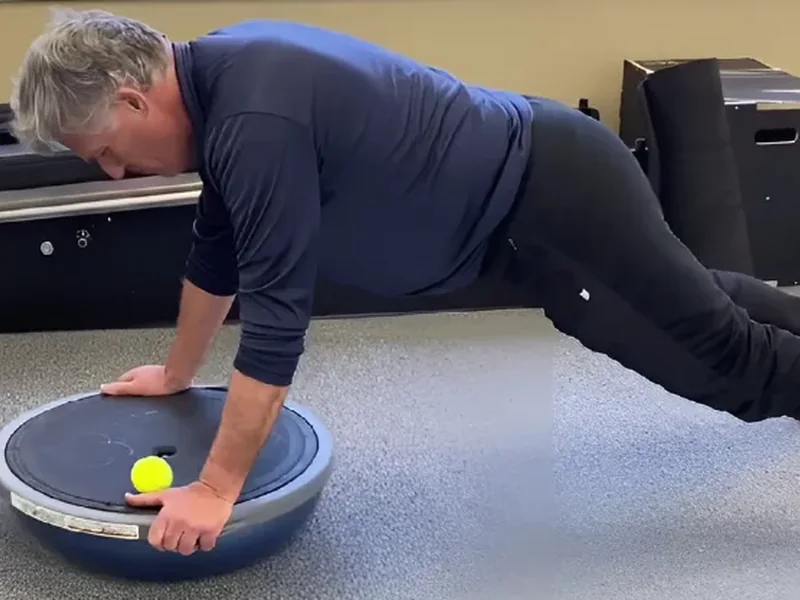
Neurological rehab is the work of practising a better pattern often enough and hard enough that it sticks. That means gait retraining with real cueing rather than a treadmill and hope, balance training progressed until it is genuinely challenging, loaded strength work, and task-specific practice: the actual transfer, the actual stair, the actual reach into the actual cabinet.
This is what our founder has built the practice around. Seth Greiner, PT, MSPT has put hundreds of hours of continuing education into neurological care, most recently Parkinson’s management, and he is the head coach of Rock Steady Boxing Hampton Bays. We also coordinate with your neurologist, and with an orthotist or prosthetist where a brace or a device is part of the answer.
Who we see for neurological rehab.
Any stage, from newly diagnosed to years in and looking for a reset.
Parkinson’s disease
Small steps, rigidity, freezing and reduced arm swing all respond to large-amplitude, high-effort work.
Stroke recovery
Rebuilding gait, single-side strength and the confidence to load a leg that stopped being trusted.
Multiple sclerosis
Programming built around fatigue and heat sensitivity, so training helps rather than costs you the next two days.
Peripheral neuropathy
When feet stop reporting position accurately, balance strategy and footwear both have to change.
Gait and balance disorders
A walk that has quietly gotten slower, shorter and more careful, whatever the label on it.
Spinal cord and nerve injury
Post-surgical and post-injury work on strength, transfers and functional independence.
What you get out of it.
Function first. Everything here is measured against something you do on a normal Tuesday.
A better walk
Longer steps, more speed, a real turn instead of a shuffle, and more arm swing.
Lower fall risk
Balance and reaction strategies trained hard enough that a stumble stays a stumble.
Real strength
Loaded work for the hips, legs and trunk, which is what stairs, curbs and getting off the floor actually require.
Independence in daily tasks
Transfers, dressing, the car, the kitchen. We rehearse the specific task rather than a proxy for it.
Family who know the plan
The people helping you get trained too, on cueing, transfers and what to do when something changes.
One therapist, the whole hour
No aides, no assistants. Neurological progress depends on precise cueing, and precise cueing depends on someone who knows you.
Questions about neurological rehab.
01 / Do I need a referral from my neurologist?
02 / Do you offer speech therapy or occupational therapy?
03 / How long does neurological rehab take?
04 / Is it too late to start?
What our patients say.
"I recently had a life changing accident resulting in a serious spine injury. Post operative care and therapy has been amazing. Great Dr's and staff."Eric T. · Spine injury recovery
Schedule Your Appointment
No referral needed in New York. Same-week appointments available at both locations.
Your first visit is a full one-on-one evaluation with a licensed physical therapist: come in, tell us everything, and leave with a plan.
You’re all set.
We’ll reach out within one business day to confirm your appointment. If you need to speak with us sooner, call us directly.