

Golf Injury Rehab in the Hamptons
For the golfer who is playing hurt. We treat the injury, fix what in your body caused it, and get you back on the course without the compensation that created the problem.
Playing through it is how a strain becomes a season.
A golf injury almost never starts in the tissue that hurts. A hip that will not rotate makes the low back do the turning. A stiff thoracic spine sends the shoulder looking for range it does not have. A grip compensation loads the wrist and the medial elbow every single swing. So you can rest the painful part, feel better for two weeks, and re-injure it on the first tee, because the reason was never treated.
Golf rehab is the injury side of our golf work. We treat what hurts and we find what caused it. That means hands-on care where the tissue needs it, including Active Release Technique for adhesion and scar tissue, joint mobilization for the segments that stopped moving, and blood flow restriction training when we need to build strength in a limb that cannot yet tolerate heavy load. Then progressive loading, neuromuscular re-education, and a look at what in your swing is asking your body to do something it currently cannot.
If you are not injured and you want speed and consistency, that is golf performance. If you are not sure which you need, start with the TPI screen, which tells us both.
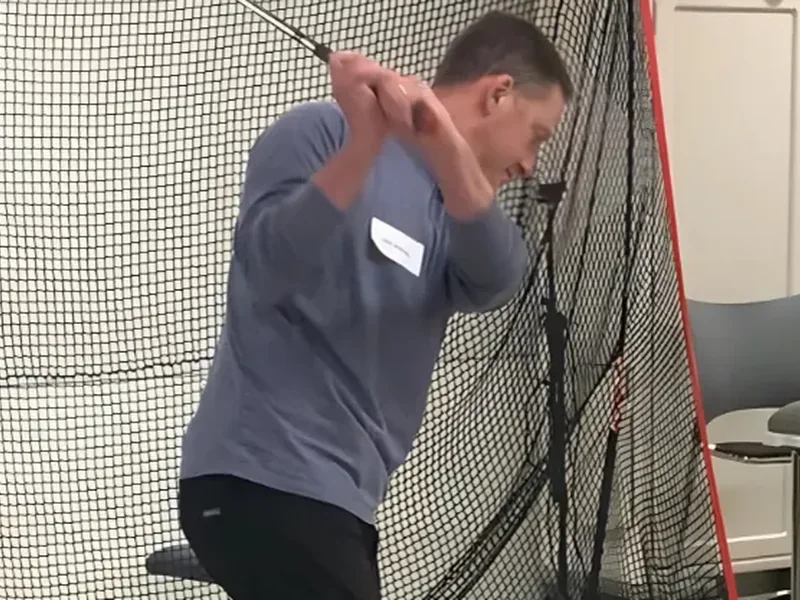
The golfers we see.
Recreational players through low handicaps, and a lot of people who waited too long.
Low back pain
The most common golf complaint we treat. Rotational load with nowhere else to go, plus a hip or thoracic spine that stopped contributing.
Shoulder pain
Rotator cuff irritation and impingement in the lead shoulder, usually with a stiff thoracic spine behind it.
Elbow and wrist
Medial and lateral elbow tendinitis, plus wrist pain from grip compensation and turf contact.
Hip and knee
Restricted hip rotation, hip impingement, and knee pain from the load the trail leg takes through the downswing.
Post-surgical golfers
Back, shoulder, hip or knee surgery, with a return-to-golf plan rather than a general discharge.
Pain that keeps coming back
It settles over the winter, it returns in May. That pattern is a mechanics problem, and it is fixable.
What you get out of it.
Back on the course, and less likely to end up here again in a year.
The pain settles
Hands-on treatment plus load management, aimed at the tissue that hurts and the reason it is overloaded.
Rotation you can actually use
Hip and thoracic range restored and then trained, so the low back stops doing the turning.
Strength through a full round
Progressive loading so hole 16 looks like hole 3, which is when most swings fall apart.
A return-to-golf plan
A graded progression from putting to a full round, on criteria, instead of a guess and a hopeful Saturday.
The cause addressed
We treat what created the injury, not only what hurts, which is what stops the annual recurrence.
One therapist the whole hour
Every visit is you and a licensed physical therapist. No assistants, no aides.
Questions about golf rehab.
01 / Do I need a referral from my doctor?
02 / Can I keep playing while I am in rehab?
03 / How is this different from golf performance?
04 / Do you look at my swing, or just my body?
What our patients say.
"Seth is practically a miracle worker! I am in less pain and have better range of motion than I have had in decades! Literally. This far exceeds my expectations!"Lynne J. · Long-standing pain
Schedule Your Appointment
No referral needed in New York. Same-week appointments available at both locations.
Your first visit is a full one-on-one evaluation with a licensed physical therapist: come in, tell us everything, and leave with a plan.
You’re all set.
We’ll reach out within one business day to confirm your appointment. If you need to speak with us sooner, call us directly.