

Fall Prevention in Quogue, NY
One fall changes what you are willing to do for the rest of the year. This program lowers the risk before that happens, and it is the only one of our services that includes a walk-through of your own home.
Falls are not bad luck. They are a stack of risk factors, and most of them move.
Nobody falls for one reason. It is usually four small things at once: a hip that cannot generate a fast correction, ankles that have lost range, a medication that dulls the response, and a rug at the top of the stairs. Treat one and the risk barely moves. Treat the stack and it drops.
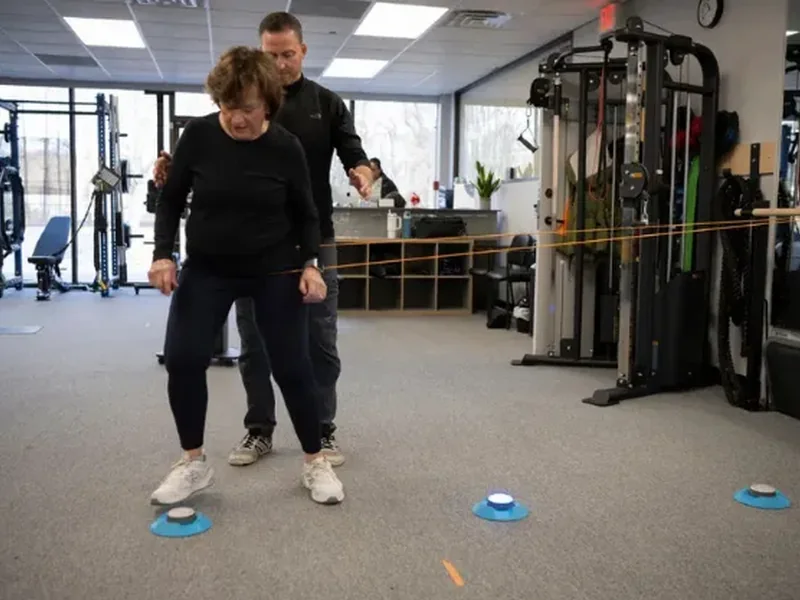
That is what this program does. We screen the physical risk factors, train the ones that respond to training, and then we look at where you actually fall, which is almost never a clinic. The home safety evaluation is the part that separates this from balance work: lighting on the stairs and in the hallway you use at night, the bathroom, the thresholds and cords and rug edges, the height of the chair you get out of most, and the furniture path you take in the dark.
Family members and caregivers are welcome in the sessions, and often should be. If somebody is helping you up out of a chair, they should learn to do it in a way that does not hurt either of you.
Who this program is for.
Mostly active adults in the Hamptons who have decided not to wait for the fall.
You have already had a fall
Even one without an injury. A first fall is the single strongest predictor of the next one, and it is the best reason to start.
You are afraid of falling
Fear makes the walk shorter, stiffer and more careful, which is exactly what makes a fall more likely. It is treatable, not a personality trait.
Getting out of a chair is work
If you push off the arms or rock forward to stand, the hip and leg strength you need to catch a stumble is not there yet.
Osteoporosis or low bone density
When a fall means a fracture, the math changes. Prevention and loaded strength work both matter more.
Neuropathy or a neuro diagnosis
Numb feet and Parkinson’s both interrupt the information your balance system depends on. The strategy has to change with it.
A family member is worried
Half of the calls we get about this come from an adult child. That is a legitimate reason to book a screen.
What you get out of it.
The point is not a score. It is that you keep doing the things you were about to give up.
Power to catch yourself
Stumbles become stumbles instead of falls, because the hip and ankle response is fast enough and strong enough.
A house that stops helping
The written home list turns your own home from a set of hazards into a place that no longer participates.
Fear that stops shrinking your life
Confidence on stairs, in the dark, on gravel and in a crowd, which is the difference between going out and staying home.
Independence you keep
Stay in your own house, drive your own errands, get up off the floor without waiting for help.
Caregivers who know what to do
Family training on transfers, cueing and when to call, so helping does not turn into two injured people.
A plan for after discharge
A short maintenance routine and clear rules for when to come back in for a tune-up.
Questions about fall prevention.
01 / Do I need a referral, and how does insurance work?
02 / Is this the same as balance therapy?
03 / Does someone actually come to my house?
04 / I have not fallen. Is it too early?
What our patients say.
"The physical therapy at Greiner is excellent. The staff is dedicated, knowledgeable and caring. My husband has been very pleased with all aspects of the PT at Greiner."Marianne L. · Google review
Schedule Your Appointment
No referral needed in New York. Same-week appointments available at both locations.
Your first visit is a full one-on-one evaluation with a licensed physical therapist: come in, tell us everything, and leave with a plan.
You’re all set.
We’ll reach out within one business day to confirm your appointment. If you need to speak with us sooner, call us directly.