

Back Pain & Sciatica Treatment in Speonk, NY
You have rested it, stretched it, and taken something for it. It keeps coming back because nothing has changed about how your back gets loaded. That is the part we treat.
Book Your First Visit
No referral needed in New York · Same-week appointments at Speonk and Quogue.
You’re all set.
We’ll reach out within one business day to confirm your appointment. If you need to speak with us sooner, call us directly.
The lift did not cause this. It was the last thing your back could take.
Backs rarely fail from one event. They fail from months of the same loading pattern: hips that stopped extending, a core that stopped bracing in time, a lumbar spine covering for both. Then you pick up a bag of mulch and the tissue that has been quietly absorbing all of it finally reports in. That is why the flare feels sudden and the cause is not.
Sciatica is a different animal from ordinary back pain and it should be treated like one. When the sciatic nerve or its roots get compressed or chemically irritated, the pain travels: through the buttock, down the back of the thigh, sometimes to the calf and foot, often with pins and needles or a leg that feels heavy and unreliable. Not all leg pain is sciatica, and the difference decides the plan.
Resting the back settles the flare and leaves the mechanism intact, which is why it comes back a little easier each time. Our job is to find the movement or the tissue that is actually taking the load, calm it down by hand, then retrain the hips, trunk and spine so the load stops landing in the same place.
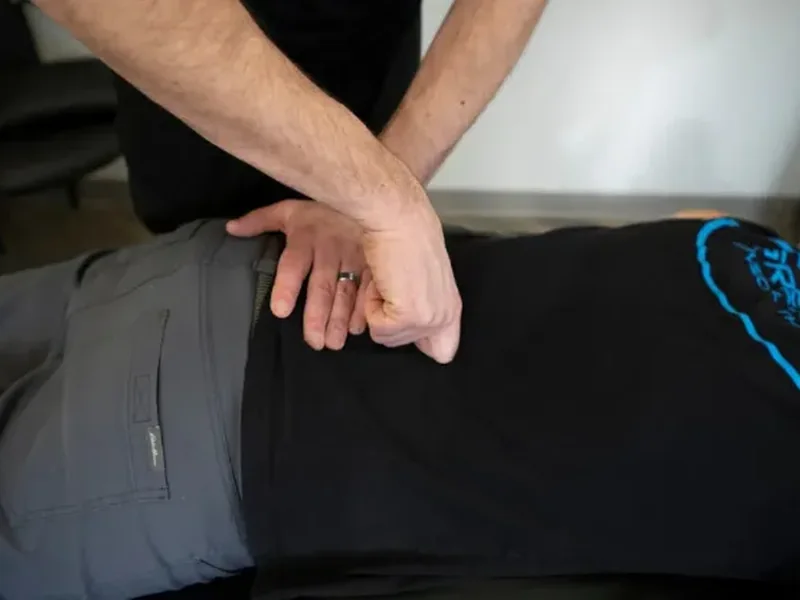
How back pain and sciatica actually present.
The pattern tells us far more than the location does, so bring the details to your evaluation.
Worse on bending, lifting or twisting
Pain when you load the spine forward, get out of the car, or reach into the back seat.
Stiff and sore first thing
The first twenty minutes of the day are the worst, and it loosens once you are up and moving.
Pain that travels down the leg
A line of pain through the buttock and thigh, sometimes past the knee into the calf or foot.
Pins, needles or numbness
Tingling, burning, or patches of skin that feel dull, usually along one specific path.
Sitting makes it worse
Long drives, desks and dinner tables aggravate it, and standing up out of the chair is the hardest part.
A leg that feels weak
The foot catches, the calf tires early, or pushing off that leg feels unreliable.
How we treat back pain and sciatica.
The evaluation comes first and it is done by the therapist who will treat you. We test what provokes it and what relieves it, screen the nerve, then check the hips, trunk and thoracic spine, because a stiff hip or a locked mid-back is one of the most common reasons a low back keeps getting overworked. Imaging is often not the first step, and we will tell you plainly if your findings say otherwise.
Treatment starts hands-on: joint mobilization for the segments that have stopped moving, soft tissue and trigger point work for the muscles guarding around them, Active Release Technique where tissue is stuck, and spinal manipulation where it is indicated and you are comfortable with it. Nerve-related symptoms get graded work to take the pressure and the irritability off the nerve, in the order the nerve tolerates.
Then the part that keeps it away: hip and trunk strength, timing drills so the core braces before the load arrives, and correcting the specific movements that provoke you, from a golf backswing to how you get up off the floor with a grandchild.
No referral needed in New York for up to 30 days or 10 visits. In network with Medicare and Medicare Advantage, out of network with most other plans, and we submit claims on your behalf. Same-week appointments are usually available at both locations.
Questions about back pain and sciatica.
01 / Do I need a doctor referral or an MRI before physical therapy?
02 / I stretch my hamstrings constantly and it is not helping. Why?
03 / Should I rest or keep moving?
04 / What about insurance?
What our patients say.
"I recently had a life changing accident resulting in a serious spine injury. Post operative care and therapy has been amazing. Great Dr's and staff."Eric T. · Spine injury recovery
Schedule Your Appointment
No referral needed in New York. Same-week appointments available at both locations.
Your first visit is a full one-on-one evaluation with a licensed physical therapist: come in, tell us everything, and leave with a plan.
You’re all set.
We’ll reach out within one business day to confirm your appointment. If you need to speak with us sooner, call us directly.