

Spinal Manipulation in Quogue, NY
One controlled, low-amplitude thrust to one restricted spinal segment. Screened for first, and always paired with the exercise that keeps the segment moving.
One segment, one thrust, and then the work that makes it last.
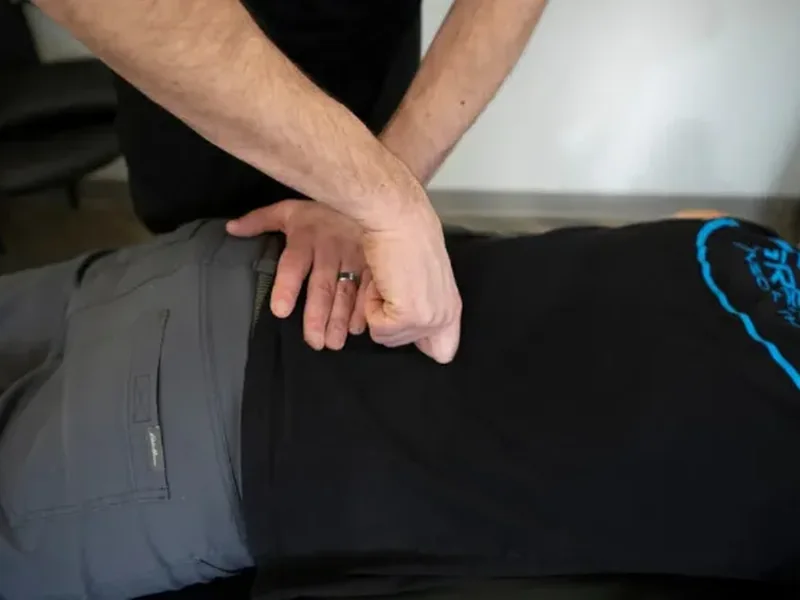
Spinal manipulation is a high-velocity, low-amplitude thrust delivered by hand to a single spinal segment that has stopped moving. The movement is small and fast, taken to the end of the range the joint already has and no further. The pop you may hear is cavitation inside the joint, a pressure change, not a bone going back into place. Nothing is cracked and nothing is twisted at speed.
The point is segmental motion. When one level of the spine locks up, the levels above and below take over its share of movement, the local muscles guard, and the nerve exiting at that level can get irritated. Restoring glide at the stuck level takes the load off its neighbours and lets the guarding settle.
A thrust on its own is temporary. What holds it is the stabilizing exercise you get in the same visit, plus the posture and ergonomic changes that stop the segment locking again by Thursday. This is the higher-intensity half of a pair. If a thrust is not appropriate for you, spinal mobilization does the same job without one.
Who manipulation suits.
Stiff and locked, rather than acutely inflamed or fragile. Those cases belong on the mobilization page.
Locked, Stiff Low Backs
Backs that feel jammed rather than sore, worst first thing in the morning or after a long stretch of sitting.
Neck Stiffness & Headaches
Limited rotation, a rigid upper back, and headaches that start at the base of the skull.
Golfers Losing Rotation
Mid-back segments that will not turn, which the swing then borrows from the low back instead.
Lifters With A Stuck Mid-Back
Overhead and front rack positions that a stiff thoracic spine keeps turning into a shoulder problem.
What a well-placed thrust does.
You can test three of these four before you leave the room.
Segmental Motion Back
The stuck level moves again, so its neighbours stop covering for it.
A Change You Can Test
You bend, turn or look over your shoulder straight afterward and feel whether it worked.
Less Nerve Irritation
Freeing an irritated level often quiets the symptoms referring down the arm or the leg.
A Plan Beyond The Table
The exercise, the posture change, and what to do if the segment locks up again.
Questions about spinal manipulation.
01 / Is this the same as a chiropractic adjustment?
02 / Is it safe, and what are the side effects?
03 / What if I do not want to be manipulated?
04 / Do I need a referral first?
What our patients say.
"The most incredible PT I have ever experienced. Peter Imperato is the best therapist."Greiner patient · Testimonial
Schedule Your Appointment
No referral needed in New York. Same-week appointments available at both locations.
Your first visit is a full one-on-one evaluation with a licensed physical therapist: come in, tell us everything, and leave with a plan.
You’re all set.
We’ll reach out within one business day to confirm your appointment. If you need to speak with us sooner, call us directly.