

TPI Golf Assessment in Speonk, NY
The Titleist Performance Institute 16-movement screen. An objective physical map of what your body can and cannot do inside a golf swing, and the entry point to everything else we do for golfers.
Book Your First Visit
No referral needed in New York · Same-week appointments at Speonk and Quogue.
You’re all set.
We’ll reach out within one business day to confirm your appointment. If you need to speak with us sooner, call us directly.
Before anyone changes your swing, find out what your body is allowed to do.
Your swing is limited by your body before it is limited by your technique. If your hips cannot separate from your shoulders, you cannot make the turn your coach is asking for, no matter how many lessons you take. You will find another way to do it, which is what a swing fault actually is: a physical limitation with a workaround built on top of it.
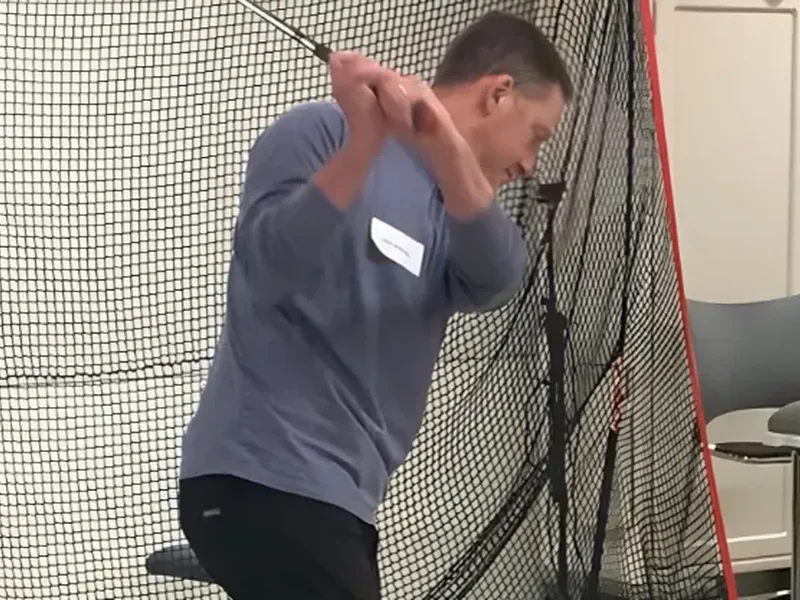
The TPI screen is the Titleist Performance Institute’s way of finding those limitations. It is 16 golf-specific movements, tested one at a time and graded on a traffic-light system, that assess mobility, stability and strength through the whole chain from your ankles to your shoulders. It includes the relationship between hip and shoulder rotation, the separation golfers call the X-factor, which is where a large share of both power and back pain comes from.
Seth Greiner, PT, MSPT is TPI certified and runs the screen. This is the entry point to our golf work: what it finds determines whether you belong in golf performance, in golf rehab, or in an ongoing training block. It is also useful on its own, and plenty of golfers take their results back to their coach and go no further.
Who should get screened.
Any golfer, any handicap. These are the reasons people book it.
Inconsistent ball striking
The move works on Tuesday and vanishes on Saturday. Usually a mobility or stability limit that shows up under speed.
Distance that has gone
Nothing hurts, the ball just goes shorter. The screen tells you which physical quality left.
Lessons that will not stick
Your coach keeps asking for the same correction. The screen shows whether your body can physically make it.
Nagging golf aches
Low back, lead shoulder, elbow. Catching the limitation behind it before it becomes an injury is the cheapest version of this.
Former athletes
You played at a high level, something got stiff along the way, and you want to know what specifically.
Anyone starting a program
Before you spend a winter training, find out what to train. A screen is the difference between a plan and a guess.
What you walk out with.
A screen is only worth doing if you leave with something concrete.
Sixteen graded results
Every movement scored green, yellow or red, so you know exactly where your body is limited.
Your rotation picture
Hip and shoulder separation measured, because that relationship drives both clubhead speed and low back load.
Findings tied to swing faults
Each limitation connected to the swing characteristic it produces, instead of a list of numbers with no meaning.
A corrective plan
The specific exercises for your reds and yellows, delivered as video in our home-exercise app.
A recommendation
An honest answer about whether you need performance training, treatment, or nothing more than the plan you just got.
Something to give your coach
Your results in a form your golf professional can actually use, so their plan and ours agree.
Questions about tpi golf assessment.
01 / Is the screen 12, 15 or 16 movements?
02 / Do I need a referral, and is it covered by insurance?
03 / Do I need to bring clubs, or hit balls?
04 / What if the screen finds something painful?
What our patients say.
"Greiner Physical Therapy delivers an exceptional level of care that truly sets them apart."Brian M. · Google review
Schedule Your Appointment
No referral needed in New York. Same-week appointments available at both locations.
Your first visit is a full one-on-one evaluation with a licensed physical therapist: come in, tell us everything, and leave with a plan.
You’re all set.
We’ll reach out within one business day to confirm your appointment. If you need to speak with us sooner, call us directly.