

Balance Therapy in Speonk, NY
If the room tilts when you turn your head, or the floor feels further away than it used to, that is a treatable problem. Balance therapy finds which of the three systems that keep you upright is failing, and retrains it.
Standing up straight is a skill, and it can be coached back.
Balance is not one thing. It is your inner ear, your eyes and your body’s own position sense arguing until they agree, and then your hips and ankles making the correction before you notice one was needed. When one of those three inputs stops reporting honestly, the other two overwork, and you feel it as dizziness, as a wobble when you turn, or as a walk that has quietly gotten shorter and more careful.
Balance therapy is the clinical treatment of that problem. Your therapist tests the vestibular system, watches your gait, checks how well your eyes stay fixed on a target while your head moves, and measures the ankle and hip strength you need to make a correction. Then you train the part that failed: gaze stabilization for the inner ear, single-leg stance and heel-to-toe walking for postural control, ankle mobility and hip strength for the correction itself, and dynamic gait work for real walking on real ground.
Every session is you and a licensed physical therapist, start to finish. Nobody hands you off to an aide and walks away, which matters more here than almost anywhere else, because balance training only works when it is hard enough to be interesting and supervised enough to be safe.
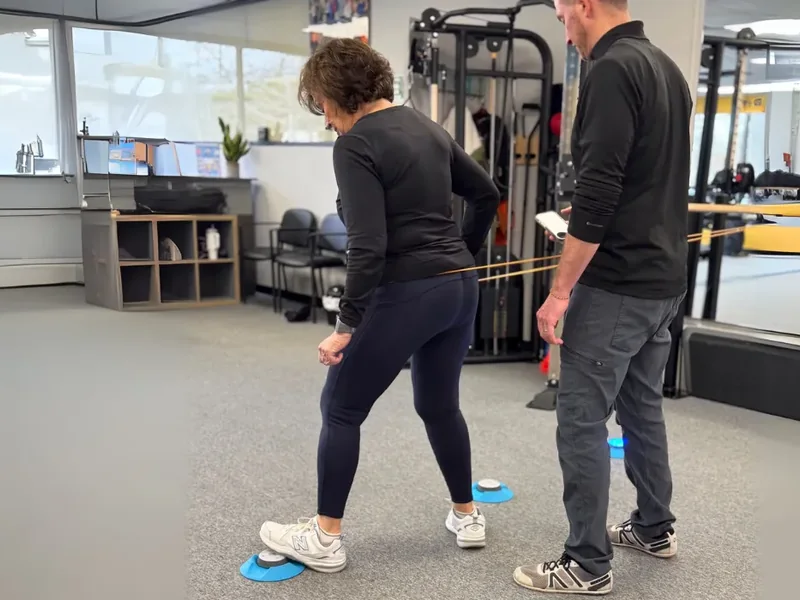
Who balance therapy is for.
These are the people we see most often for this work at the Speonk and Quogue clinics.
Dizziness and vertigo
Spinning with position changes, BPPV, motion sensitivity, or a head that takes a second too long to settle when you sit up.
Unsteady when you turn
You are fine walking a straight line and unreliable the moment you pivot in the kitchen or step off a curb.
After a joint replacement
A new hip or knee changes how you load that leg, and balance does not come back on its own just because the surgery went well.
Neurological diagnoses
Parkinson’s, multiple sclerosis, stroke recovery and peripheral neuropathy all change the information your feet send up.
After time off your feet
A hospital stay, a long illness or a winter of inactivity takes strength and position sense with it, faster than most people expect.
Active adults noticing a change
You have not fallen. You have started holding the rail, and you would rather deal with it now than after something happens.
What you get out of it.
Concrete changes, not a promise of a cure.
Fewer dizzy episodes
Position changes and head turns stop triggering the spin, or trigger it less and for less time.
A longer, steadier stride
Gait retraining gets the shuffle and the guarded short step out of your walk, which is also what makes you faster.
Strength where corrections happen
Hips and ankles strong enough to catch a stumble instead of just reporting one.
Confidence you can feel
Stairs without the rail, a dark hallway, a crowded room. Most patients notice this before the test numbers change.
A program you understand
Video of your own drills in the app, plus the reasoning, so you can keep the gains after discharge.
One therapist, every visit
The same licensed physical therapist who tested you is the one progressing you. No assistants, no aides.
Questions about balance therapy.
01 / Do I need a doctor’s referral for balance therapy?
02 / How is this different from your fall prevention program?
03 / What should I wear and how long is a session?
04 / Is balance training safe if I am already unsteady?
What our patients say.
"The team at Greiner not only helped me enormously, they did so with lots of patience and tips to help me at home. The treatments improved my pain and weakness."Susan H. · Google review
Schedule Your Appointment
No referral needed in New York. Same-week appointments available at both locations.
Your first visit is a full one-on-one evaluation with a licensed physical therapist: come in, tell us everything, and leave with a plan.
You’re all set.
We’ll reach out within one business day to confirm your appointment. If you need to speak with us sooner, call us directly.