

Balance & Gait Disorder Treatment in the Hamptons
You have started planning your day around what you can hold onto. Balance is a trainable skill, and getting it back begins with measuring exactly which part of it failed.
Steadiness is not a personality trait. It is three systems agreeing with each other.
Standing upright is a running negotiation between what your inner ear senses, what your eyes see, and what the nerves in your feet and joints report about where you are. Your brain compares the three and adjusts, constantly. Take out or degrade any one of them, through a neurological condition, an inner ear problem, nerve damage in the feet, changing vision, or the side effects of a medication list, and the other two have to work harder. When they cannot keep up, you get unsteady.
What follows is a second problem that is often bigger than the first. You walk slower, take shorter steps, stop turning your head while you move, hold the furniture, and stop going out. Every one of those adaptations reduces the input your balance system needs to stay sharp, so it degrades further. The unsteadiness and the caution feed each other.
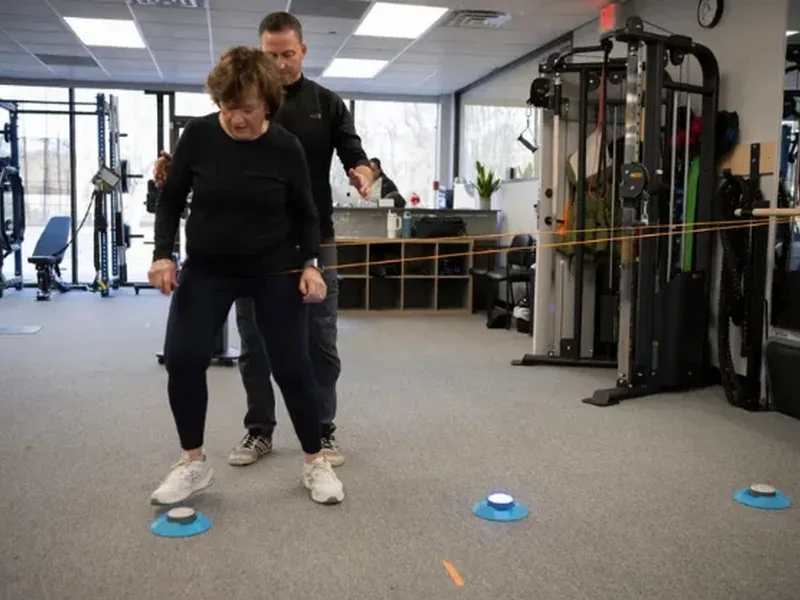
That is a trainable problem, and it is our job to prove it with numbers rather than reassurance. We measure your walking, your ability to stand and sit repeatedly, how you handle turning and head movement, your leg strength and your ankle and foot mobility, and we review your medication list with you so we can raise the ones known to cause unsteadiness with your physician. Then we train the specific system that is letting you down.
The signs worth acting on now, not next year.
These are the findings that predict a fall, and every one of them responds to training.
Turning has become the hard part
You plan turns in the kitchen, or you take several small steps instead of one confident pivot.
The room moves when you do
Standing up quickly, looking up at a shelf, or rolling over in bed brings on spinning or a swimmy feeling.
Catching a toe
You scuff or trip on thresholds, rugs and curbs, especially late in the day when the leg is tired.
A shorter, wider, slower walk
Steps have got smaller, the feet further apart, and you cannot cross a road in one light anymore.
Furniture walking
You touch the counter, the wall, the back of the chair. You may not have noticed when that started.
You have stopped going places
Uneven lawns, gravel drives, dim restaurants and beach paths quietly came off the list.
How we retrain balance and walking.
Everything starts with the assessment, because balance is not one thing. We look at gait speed, step length and symmetry, how long you can walk before quality falls apart, how many times you can rise from a chair, standing tolerance with your eyes open and closed, head turns while walking, ankle and hip mobility, and whether your current cane or walker is helping or hurting you. Those numbers become the baseline you get measured against later.
Treatment then loads the system that is weak. Sensory and postural retraining with controlled, progressively harder challenges. Ankle, foot and hip strength, including the intrinsic foot muscles and the sit-to-stand work that predicts falls better than almost anything else. Gait training with the right assistive device, fitted and taught properly. Endurance work, because a walk that is safe for the first block and not the fifth is not yet safe.
Balance therapy and fall prevention are two different jobs and we do both. Balance therapy retrains the system itself. Fall prevention deals with the environment and the risk around it: the stairs, the rugs, the lighting, the footwear, the medication conversation, and what to do if you do go down. Most patients need some of each, and we tell you which one you are actually here for.
No referral needed in New York for up to 30 days or 10 visits. In network with Medicare and Medicare Advantage, out of network with most other plans, and we submit claims on your behalf. Same-week appointments are usually available at both locations.
Questions about balance and gait disorders.
01 / Do I need a referral to be seen for balance problems?
02 / How is this different from your fall prevention program?
03 / I have a neurological condition. Can therapy still help?
04 / What does it cost and does insurance cover it?
What our patients say.
"The team at Greiner not only helped me enormously, they did so with lots of patience and tips to help me at home. The treatments improved my pain and weakness."Susan H. · Google review
Schedule Your Appointment
No referral needed in New York. Same-week appointments available at both locations.
Your first visit is a full one-on-one evaluation with a licensed physical therapist: come in, tell us everything, and leave with a plan.
You’re all set.
We’ll reach out within one business day to confirm your appointment. If you need to speak with us sooner, call us directly.