

ACL Tear Rehab in Speonk, NY
You heard the pop, the knee filled up within the hour, and now you do not trust it on a turn. We rebuild the strength and the control that tell your knee it is safe to move.
A torn ACL is a control problem long before it is a strength problem.
The ACL is the strap that stops your shin sliding forward and twisting out from under you. It does that job in the fraction of a second before you could think about it, which is why one cutting step or one bad landing can take it out. The swelling and the pain are the loud part. The quiet part is that the knee loses its sense of where it is in space, and the quadriceps switches itself off to protect the joint.
That quiet part is what usually never gets rebuilt. Surgery or no surgery, the knee that gives way a year later on a wet lawn or a boat ramp is almost always a knee whose single-leg strength and landing control were never brought all the way back. A graft heals on its own schedule. Trust in the joint has to be trained into it.
So we test the knee, then we test the whole leg: the quad, the hip, the calf, how you decelerate, how you land. Every session is you and a licensed physical therapist, which means the load goes up when your knee earns it, not when a calendar says so.
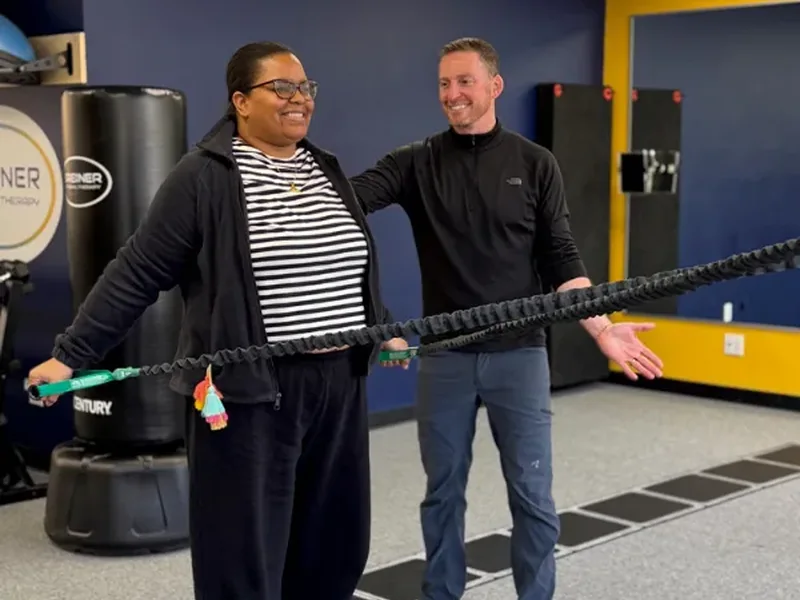
What a torn ACL feels like, in the first week and in the twelfth.
Some of these arrive within the hour. Others show up much later, the first time you ask the leg to change direction.
The pop, then the swelling
A sharp shift at the moment of injury, then a knee that fills and stiffens over the next few hours.
Giving way
The knee buckles on a turn, a curb or uneven ground, often with very little pain attached to it.
Motion you cannot get back
Full straightening and the last part of bending stay out of reach, even after the swelling settles.
A thigh that quit
The quadriceps looks smaller and will not fire hard, especially near the end of a straight-leg lift.
A limp you stopped noticing
You shorten the step, hold the knee stiff, and quietly hand the work to the other leg.
Fear of the cut
Straight-line jogging feels fine, then any plant, pivot or landing feels like a question you cannot answer.
How we rehab an ACL tear, operated or not.
Not every torn ACL goes to an operating room. A partial tear in a knee that stays stable under testing can often be managed conservatively, and that call belongs to you and your surgeon. Either way the rehab has the same shape: settle the joint, win back motion, rebuild the leg, then earn speed and direction.
Early on that is hands-on work to clear swelling and recover full extension, quadriceps re-education so the muscle switches back on, and carefully chosen loading. Blood flow restriction training lets us build the thigh at loads a fresh or freshly reconstructed knee can tolerate. Later it is single-leg strength, deceleration, hopping and landing mechanics, then cutting at speed while your therapist watches the knee itself.
No referral needed in New York for up to 30 days or 10 visits. In network with Medicare and Medicare Advantage, out of network with most other plans, and we submit claims on your behalf. Same-week appointments are usually available at both locations.
Questions about acl tear.
01 / Do I need a referral or an MRI before I start ACL rehab?
02 / Can a torn ACL heal without surgery?
03 / How does insurance work here?
04 / How often will I come in?
What our patients say.
"After 6 months of him and his teammate Anthony I am feeling confident to go on with my life. I am able to run without pain."Greiner patient · Return to running
Schedule Your Appointment
No referral needed in New York. Same-week appointments available at both locations.
Your first visit is a full one-on-one evaluation with a licensed physical therapist: come in, tell us everything, and leave with a plan.
You’re all set.
We’ll reach out within one business day to confirm your appointment. If you need to speak with us sooner, call us directly.