

Knee Replacement Rehab in Quogue, NY
Motion after a knee replacement is a window, not a permanent option. What you win in the first weeks is largely what you keep, and that is why the early work matters so much.
The new knee will heal into whatever range you give it. That is the whole reason the early weeks are urgent.
A knee replacement is a bigger deal for motion than a hip is. The joint is repaired, then scar tissue starts laying down inside and around it, and it will organise around whatever range of motion you are actually using. Get full straightening and a good bend early and the knee heals into a usable joint. Let it settle short, and the stiffness gets progressively harder to reverse. That is why we chase full extension in the first sessions rather than waiting for comfort.
The second problem is the quadriceps. Swelling and surgical trauma switch the quad off, and it does not turn itself back on just because the pain settles. A quiet quad means a knee that buckles on stairs, cannot control a step down, and gets loaded through the joint instead of the muscle. Rebuilding it deliberately is the difference between a knee that works and a knee that merely stops hurting.
Both problems are on a clock, and both are the reason a full session with the same licensed physical therapist matters more here than almost anywhere else. Getting the last ten degrees of extension is hands-on work with someone paying attention, not five minutes on a machine while a room of four patients cycles through.
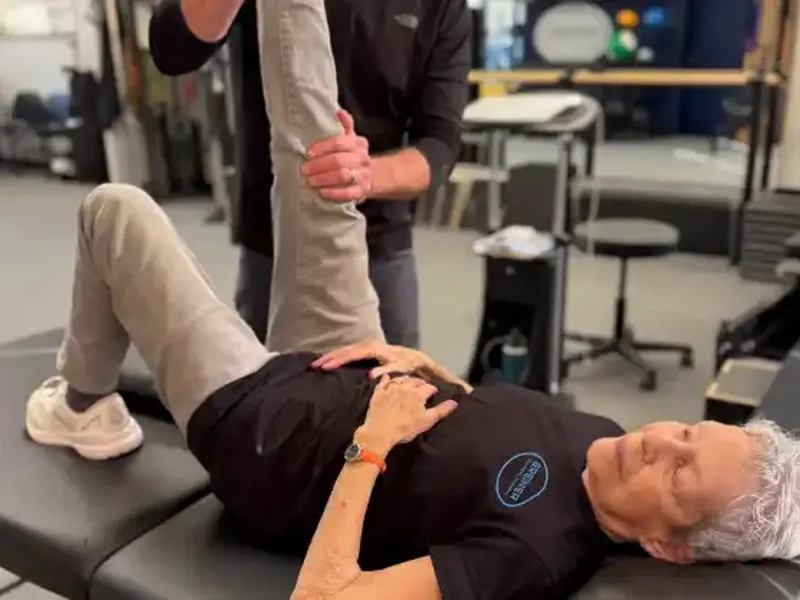
What we work on after a knee replacement.
Whether you are two weeks out or two years out, the list is usually some version of this.
A knee that will not fully straighten
The last few degrees of extension are missing, which changes how you walk and tires the leg fast.
A bend that has stalled
Getting into a car, onto a bike or up from a low chair is limited by how far the knee will flex.
A quadriceps that will not fire
The thigh looks smaller, the knee feels unsupported, and stepping down is the hardest thing you do.
Swelling and heat that keep coming back
The knee fills after activity, which limits motion and shuts the quad down further.
Stairs one leg at a time
You lead with the good leg both directions, and going down is worse than going up.
A limp and a leaned-on cane
The step is short, the knee stays stiff through it, and the other leg is taking the difference.
How we rehab a knee replacement.
We measure first and then treat, every visit. Extension and flexion in degrees, swelling, quad activation, how you rise from a chair, how you walk, and how you manage a step. Those numbers are how you and your therapist both know whether this week worked, and they go into your home program so you are working on the same targets between visits.
The hands-on work is central here. Joint mobilization to maintain and improve motion in the new knee, soft tissue and scar mobilization around the incision and the quadriceps, and patellar mobility work, because a kneecap that stops gliding limits the bend. Swelling management runs alongside all of it, since a swollen knee will not straighten and a swollen knee will not let the quad work.
Strength is the other half. Quadriceps re-education first, then progressive loading of the quads, hamstrings, glutes and calf. Blood flow restriction training lets us build the thigh at loads a fresh knee tolerates, which is genuinely useful in the early weeks. Then the functional pieces: sit-to-stand without hands, stairs foot over foot rather than leading with the good leg, walking without a device, balance work, and back to whatever you stopped doing.
No referral needed in New York for up to 30 days or 10 visits. In network with Medicare and Medicare Advantage, out of network with most other plans, and we submit claims on your behalf. Same-week appointments are usually available at both locations.
Questions about knee replacement rehab.
01 / How soon after surgery should I start, and why the urgency?
02 / How is this different from rehab after a hip replacement?
03 / What about a referral and insurance?
What our patients say.
"I had my second knee replacement surgery and had wonderful results with the first one when I was treated by Anthony. He is an excellent therapist and I highly recommend this practice to anyone."Phillip R. · Knee replacement recovery
Schedule Your Appointment
No referral needed in New York. Same-week appointments available at both locations.
Your first visit is a full one-on-one evaluation with a licensed physical therapist: come in, tell us everything, and leave with a plan.
You’re all set.
We’ll reach out within one business day to confirm your appointment. If you need to speak with us sooner, call us directly.