

Rotator Cuff Tear Rehab in Quogue, NY
An MRI with the word tear on it is frightening, and it is not a sentence. Whether you are heading for surgery, recovering from it, or trying to avoid it, the shoulder still has to be rebuilt by hand.
Book Your First Visit
No referral needed in New York · Same-week appointments at Speonk and Quogue.
You’re all set.
We’ll reach out within one business day to confirm your appointment. If you need to speak with us sooner, call us directly.
The image shows a tear. Your function depends on something else.
Four small muscles hold the ball of the shoulder centred in a shallow socket while the big muscles move the arm. A tear in one of those tendons happens two ways: suddenly, from a fall or a heavy pull, or slowly, from degeneration over years, which is why plenty of shoulders with tears on imaging have never hurt at all. That is the most useful fact on this page. The tear on the scan and the reason your shoulder hurts are related, but they are not the same thing.
What decides whether a shoulder works is whether the remaining cuff and the muscles around the shoulder blade can still keep the joint centred under load. When they can, people lift, play and sleep with a tear present. When they cannot, the arm rides up, tissue gets compressed, night pain arrives and every attempt to push through makes it angrier.
Which is why our job is the same on both sides of a surgical decision. If you are treating this conservatively, we build the capacity that lets the shoulder work as it is. If you are having it repaired, we protect the repair through its healing timeline and then build exactly the same capacity, because a repaired tendon in a weak shoulder is still a weak shoulder.
Signs the cuff is the problem.
Shoulder pain has plenty of sources. These point at the cuff specifically.
Pain lifting the arm overhead
A painful band partway up, often easing again at the top, and worse with the arm out from the body.
Night pain and side sleeping
Waking when you roll on to it is one of the most reliable cuff complaints, and one of the most exhausting.
Weakness, not just pain
Trouble holding the arm out, or rotating it outward against resistance, is a strength finding rather than a soreness one.
Reaching behind you is gone
Seat belts, back pockets and bra clasps become the movements you plan around.
It started with one event
A fall, a catch, a heavy pull, sometimes with a pop, after which the arm never came back.
A shoulder that hitches to get there
Shrugging or leaning to lift the arm, because the cuff is no longer doing its half of the movement.
Two protocols, one standard: the same therapist, the full session.
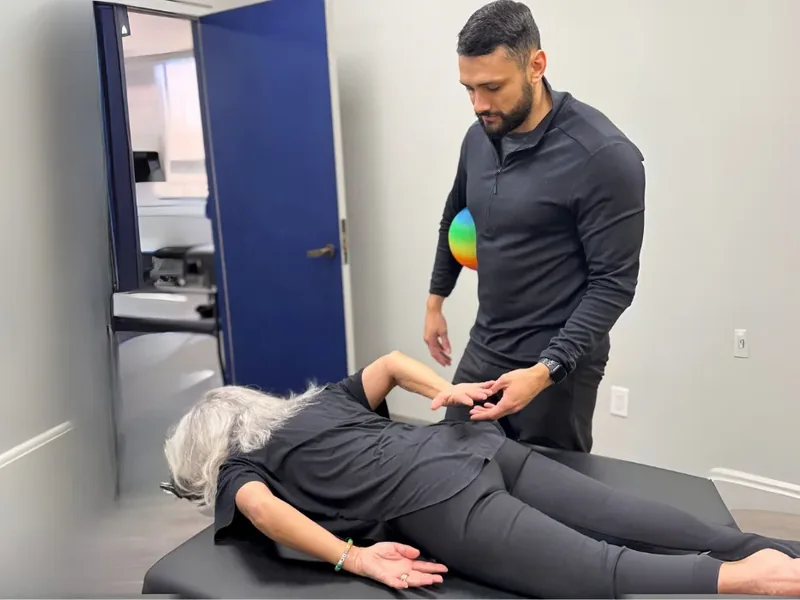
Conservative care starts with settling the irritable tissue, using manual therapy, joint mobilisation and soft tissue work to restore rotation and get you sleeping, then moves quickly into loading the cuff and the scapular stabilisers in ranges you can control before expanding those ranges. Post-surgical care follows your surgeon’s protocol precisely: sling and protected phase, passive motion, active-assisted, then active, with no early loaded external rotation and no shortcuts, because the tendon needs its healing window whatever your motivation.
Where post-surgical rehab gets frustrating is the gap between what the repair allows and the load muscle needs to grow. Blood flow restriction training is a genuinely useful tool there, letting us drive a strength stimulus with light weight while the repair is still protected. Real patients here have gone through both routes, cuff repairs and conservative programs, and what does not change is the model: no aides, no handoff, a licensed physical therapist with you for the whole session.
No referral needed in New York for up to 30 days or 10 visits. In network with Medicare and Medicare Advantage, out of network with most other plans, and we submit claims on your behalf. Same-week appointments are usually available at both locations.
Questions about rotator cuff tear.
01 / Can a rotator cuff tear heal without surgery?
02 / Do I need a referral, and will insurance cover it?
03 / I am scheduled for surgery. Should I do physical therapy before it?
04 / How long is rotator cuff rehab?
What our patients say.
"Anthony has been terrific and I am continually having more range of motion and strength in my shoulder after having rotator cuff surgery."Greiner patient · Rotator cuff surgery recovery
Schedule Your Appointment
No referral needed in New York. Same-week appointments available at both locations.
Your first visit is a full one-on-one evaluation with a licensed physical therapist: come in, tell us everything, and leave with a plan.
You’re all set.
We’ll reach out within one business day to confirm your appointment. If you need to speak with us sooner, call us directly.