

Tendinitis Treatment in Speonk, NY
Rest, ice and anti-inflammatories made it quiet, and it came back the week you went back to normal. That is not bad luck. Rest lowers the pain and the tendon’s capacity at the same time.
Book Your First Visit
No referral needed in New York · Same-week appointments at Speonk and Quogue.
You’re all set.
We’ll reach out within one business day to confirm your appointment. If you need to speak with us sooner, call us directly.
Tendons do not get better by being left alone.
The name suggests inflammation, and in a stubborn tendon that is rarely the main event. What has actually happened is a capacity problem. The tendon has been asked for more than it could tolerate, often repeatedly and often after a change in activity, and the tissue has responded by becoming disorganised, thickened and sore. That is why anti-inflammatories take the edge off without changing the story.
Tendons also have a signature you can recognise. They are stiff and sore for the first few minutes of activity, feel better once warm, then punish you a few hours later or the next morning. They hurt most when they are loaded, especially when they have to store and release energy, so running, jumping, pressing and gripping are where they announce themselves.
The treatment follows directly from that. A tendon adapts to load, and only to load. So we do not rest it into recovery, we load it in a controlled, progressive sequence that starts at an intensity it can tolerate today and builds to more than your sport or your job asks of it. Done properly, that is also the only thing that stops it recurring.
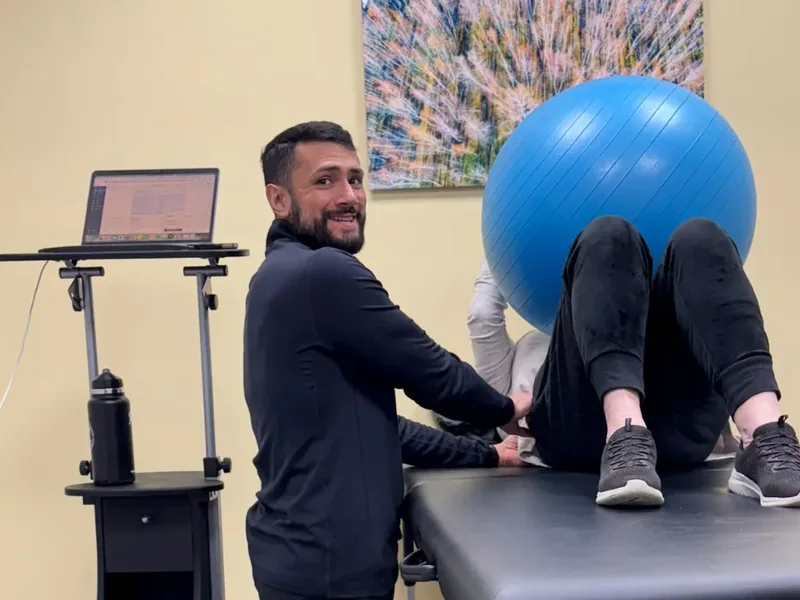
How to tell a tendon from everything else.
These patterns are consistent enough that they usually make the diagnosis before we test anything.
Stiff in the morning, better once warm
The first steps or first reps hurt, activity eases it, and then it complains again hours later.
You can put a finger on it
Tenderness over a specific, small area on the tendon rather than a vague ache spread across a joint.
Pain when the tendon is loaded
Gripping, pushing, hopping or pressing brings it on, while resting the limb makes it disappear entirely.
A thicker, lumpier tendon
Visible or palpable thickening compared with the other side, sometimes with a creaking feel on movement.
It started after a change
New mileage, a new racquet, a new job, a new program: tendinopathy usually dates to a change in load.
It keeps coming back
Repeated cycles of rest, relief and relapse are the clearest sign the tendon’s capacity was never rebuilt.
A loading program, not a rest prescription.
We start by confirming it is the tendon, finding out which activities load it and how much, and establishing your current tolerance with real testing. That gives us a starting dose instead of a guess. Hands-on work has a genuine role early on, using manual therapy and soft tissue techniques including Active Release Technique to settle the surrounding muscle and restore the joint mobility that is often part of why the tendon is overloaded.
Then we load it in stages. Isometrics first, because holding a contraction is often the one thing an angry tendon accepts and it tends to reduce pain within the session. Then heavy, slow resistance work through range, which is what actually rebuilds capacity. Then energy-storage work, hopping, springing, pressing and sport-specific speed, because that is what your tendon has to survive. Where a joint restriction limits the weight we can use, blood flow restriction training lets us keep the strength stimulus going. Every session is one on one, which is how the dose stays honest.
No referral needed in New York for up to 30 days or 10 visits. In network with Medicare and Medicare Advantage, out of network with most other plans, and we submit claims on your behalf. Same-week appointments are usually available at both locations.
Questions about tendinitis.
01 / Should I rest until the pain is gone?
02 / Do I need a referral, and how does insurance work?
03 / Would a cortisone injection be faster?
04 / How long does tendon rehab take?
What our patients say.
"Greiner is an excellent and caring facility. Systems for home excercise are top notch. I worked with Matt who did not disappoint after the very high bar set by Seth when he helped me two years ago."Richard G. · Returning patient
Schedule Your Appointment
No referral needed in New York. Same-week appointments available at both locations.
Your first visit is a full one-on-one evaluation with a licensed physical therapist: come in, tell us everything, and leave with a plan.
You’re all set.
We’ll reach out within one business day to confirm your appointment. If you need to speak with us sooner, call us directly.