

Running Injury Treatment in Speonk, NY
You took two weeks off, it felt fine, and it came back on the third run. Running injuries are load problems, so they return the moment the load returns unless something about your capacity or your training changed.
Book Your First Visit
No referral needed in New York · Same-week appointments at Speonk and Quogue.
You’re all set.
We’ll reach out within one business day to confirm your appointment. If you need to speak with us sooner, call us directly.
Almost nothing about running is a mystery. It is arithmetic.
Tissue has a capacity, running applies a load, and injuries happen where the load outgrows the capacity. That is why the same knee that handled twenty miles a week for five years falls apart at thirty, and why the injury shows up two or three weeks after the change that caused it rather than on the day. Nothing failed suddenly. The margin ran out.
There are only a handful of levers, and they are the ones we look at. How much you are running and how quickly that changed, including the spikes hidden in a race build. How you contact the ground, where cadence often does more good than any cue about form. And capacity: whether your calves can produce and absorb load repeatedly, whether your hips can control the pelvis through hundreds of single-leg landings, whether the tendon in question has been loaded in years.
Which is why rest alone fails so predictably. Two weeks off reduces the pain because it removes the load, and it also reduces the capacity, so you return to running with a lower ceiling than the one you already exceeded. The fix is to treat the sore tissue and raise the ceiling at the same time.
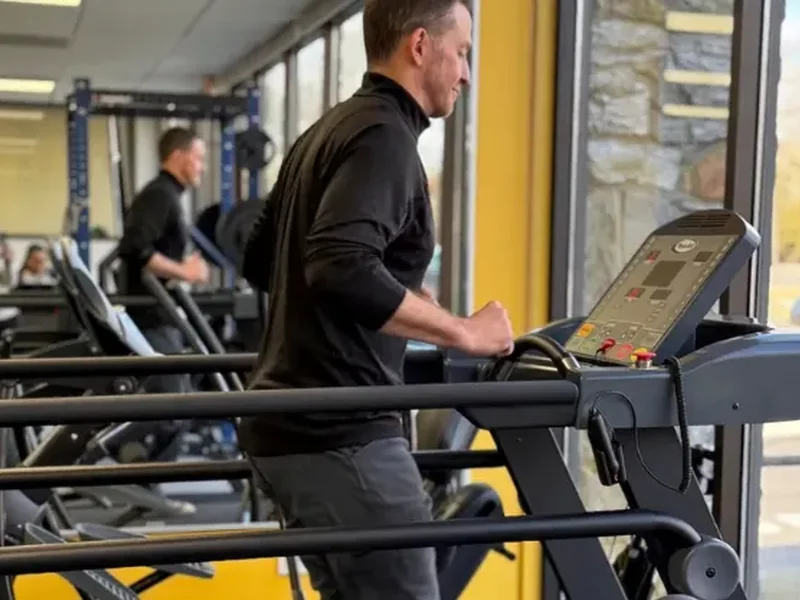
The running complaints we see most.
Pain that gets worse across a run, rather than warming up and fading, is the one to pay attention to.
Pain around or behind the kneecap
Runner’s knee, usually worse on downhills, stairs and after sitting, and usually a hip and quad capacity issue.
Shin pain that builds mile by mile
Aching along the shin that starts later in a run each week, until it starts earlier every week.
Achilles or calf pain
Stiff and sore for the first mile and the first steps in the morning, often with a thickened, tender tendon.
Heel and arch pain
Sharp first-step pain that eases as you move, then returns after standing still or driving.
Hip or outside-of-knee pain
Lateral pain that appears at a predictable distance and shuts the run down, common in a mileage build.
It always comes back at the same distance
A pain that reappears whenever you get back to a particular weekly volume is telling you exactly where your ceiling is.
Treat the tissue, fix the arithmetic, then build the return to run.
The evaluation covers the sore part and the system around it: tendon and joint testing, calf endurance measured rather than guessed, hip and quad strength, ankle and hip mobility, and how you actually move when you run, which we watch with our own eyes. We also go through your training log properly, because the spike that caused this is usually sitting in it.
Then treatment runs on both tracks. Hands-on work and graded loading for the irritated tissue, plus real capacity building for calves, quads and hips, since those are the tissues doing the absorbing. Where it helps, we work on cadence and ground contact rather than issuing a generic form cue. And we write the return-to-run progression: how far, how often, at what pace, what to do the day after, and what tells you to hold the current step instead of taking the next one.
No referral needed in New York for up to 30 days or 10 visits. In network with Medicare and Medicare Advantage, out of network with most other plans, and we submit claims on your behalf. Same-week appointments are usually available at both locations.
Questions about running injuries.
01 / Do I have to stop running completely?
02 / Do I need a referral or imaging before you can help?
03 / How does payment and insurance work?
04 / I have a race booked. Can you work around it?
What our patients say.
"After 6 months of him and his teammate Anthony I am feeling confident to go on with my life. I am able to run without pain."Greiner patient · Return to running
Schedule Your Appointment
No referral needed in New York. Same-week appointments available at both locations.
Your first visit is a full one-on-one evaluation with a licensed physical therapist: come in, tell us everything, and leave with a plan.
You’re all set.
We’ll reach out within one business day to confirm your appointment. If you need to speak with us sooner, call us directly.