
Tennis & Pickleball Injury Treatment in Quogue, NY
You are playing three or four mornings a week and something has started complaining. Nobody here is going to tell a Hamptons player to give up the court for six weeks. We would rather change what is causing it.
Pickleball is not an easier sport. It is a denser one.
Out here the courts are busy from May to October and plenty of players are on them four or five times a week, often having come to pickleball in their fifties or sixties after years away from competitive sport. That combination is what produces the injuries we see. The cardiovascular demand is modest, so it feels manageable, while the joint and tendon demand is high and relentless: short reactive steps, sudden stops, repeated overhead and lateral loading, and very little of the gradual build-up that a running or gym program would have given you.
The specifics matter too. Pickleball packs an enormous number of quick direction changes into a small court, so calves, ankles and knees absorb far more decelerations per hour than tennis. Backpedalling for an overhead is where a lot of the falls and wrist fractures come from. And the paddle is light enough that people over-rely on the wrist and forearm, which is precisely how the tendons at the outside of the elbow get overloaded.
Then there is the honest bit nobody says at open play. Most players arrive, hit two balls and start a game. Tissue that has not been prepared, in a body that has skipped its warm-up, playing a game that will not let you pace yourself. That is a load problem, and load problems are fixable without giving up the season.
What we see in tennis and pickleball players.
Court-specific complaints, from the ones that nag to the ones that end a season.
Outer elbow pain and grip loss
Tennis elbow: sore over the bony point outside the elbow, worse on backhands and when lifting a kettle or a coffee cup.
Shoulder pain serving or reaching overhead
Pain on the serve or the overhead, often with night pain, which points at the rotator cuff and scapular control.
Calf and Achilles pain
A sudden grab in the calf pushing off, or an Achilles that is stiff for the first ten minutes of every session.
Knee pain on the split step
Pain stopping, turning or lunging to the kitchen line, usually a quad and hip capacity issue rather than a knee problem.
Low back pain with rotation
Serving and open-stance forehands load the spine in rotation and extension, and it shows up the morning after.
Rolled ankles and backpedalling falls
Lateral movement and retreating for an overhead are the two highest-risk moments on a pickleball court.
Keep you playing, fix why it happened.
The evaluation looks at the sore structure and then at the court. We test grip and forearm, cuff and scapular strength, calf endurance, single-leg control and how you decelerate, and we ask about your actual week: how many sessions, how long, singles or doubles, what changed recently, what paddle or racquet and grip you are using. Playing four days a week with no strength work anywhere in it explains most of what walks through the door.
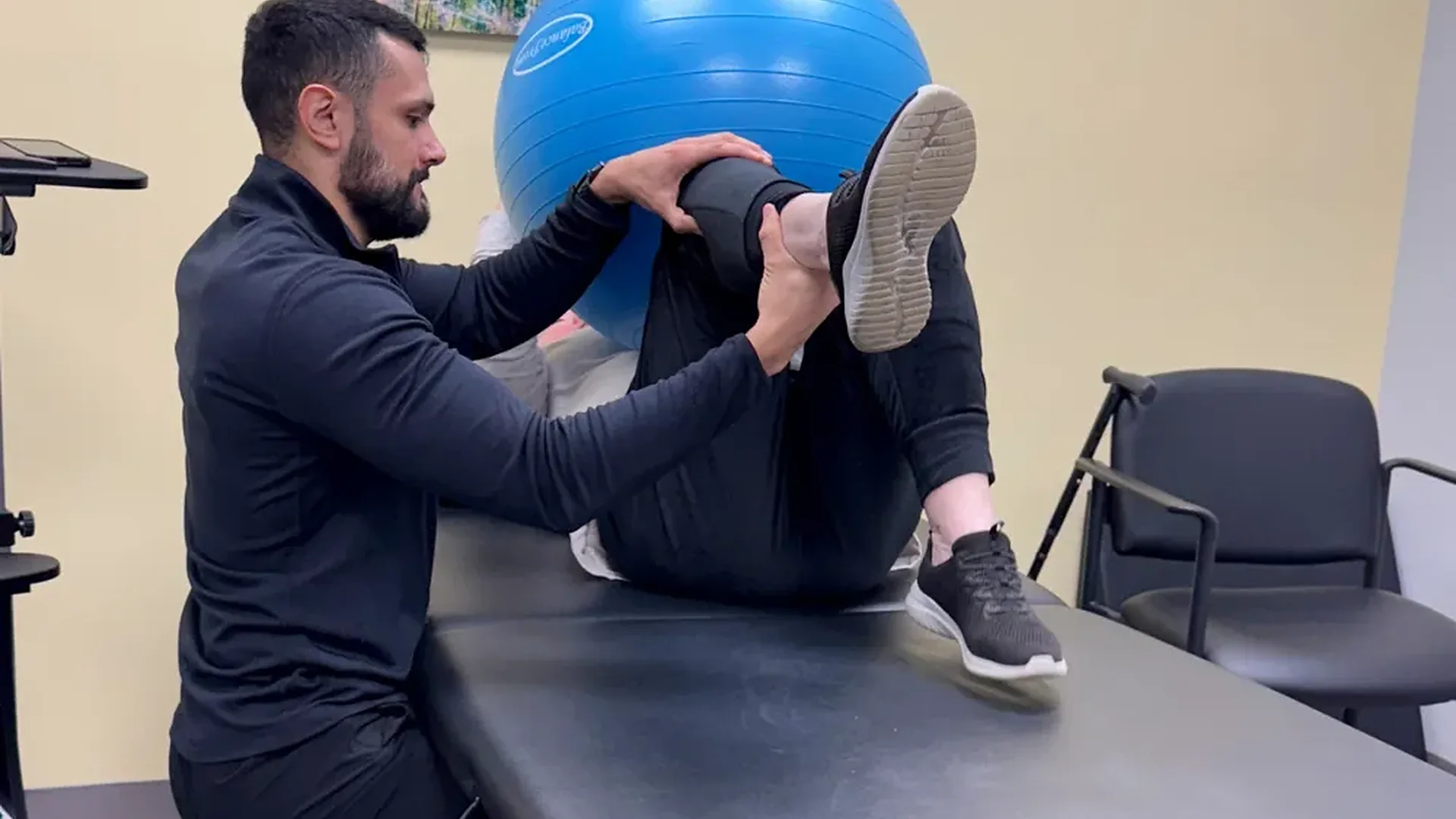
Treatment starts hands-on to settle the irritable tissue, then moves to loading the tissue that failed: forearm and grip for the elbow, cuff and shoulder blade for the serve, calf and quad capacity for the stopping and pushing off. Alongside it we build a warm-up you will actually do before you walk on court, adjust the technical and equipment factors that are worth adjusting, and manage your playing dose rather than banning it. Every session is a licensed physical therapist with you the whole time, which is why the plan can be adjusted to Wednesday’s doubles game instead of ignoring it.
No referral needed in New York for up to 30 days or 10 visits. In network with Medicare and Medicare Advantage, out of network with most other plans, and we submit claims on your behalf. Same-week appointments are usually available at both locations.
Questions about tennis & pickleball injuries.
01 / Do I have to stop playing while we treat this?
02 / Do I need a referral first, and is this covered?
03 / Will a brace or a different paddle fix my tennis elbow?
04 / I am in my sixties and play four times a week. Is that the problem?
What our patients say.
"If you're looking for physical therapy this is the place to be! One on one training, practitioners who listen and invite feedback, and an app to help with at home exercises."Sheryl D. · Google review
Schedule Your Appointment
No referral needed in New York. Same-week appointments available at both locations.
Your first visit is a full one-on-one evaluation with a licensed physical therapist: come in, tell us everything, and leave with a plan.
You’re all set.
We’ll reach out within one business day to confirm your appointment. If you need to speak with us sooner, call us directly.