

Elbow, Wrist & Hand Pain Treatment in Quogue, NY
A brace and two weeks off settled it, then the first real day of work brought it straight back. Tendons do not need rest, they need loading in the right order.
Nothing tore. The demand on the tendon outgrew what the tendon could handle.
Almost everything the arm does ends at the hand, and it all passes through a small amount of tendon at the elbow and wrist. Tendon copes with load by adapting to it, slowly. Ask for more than it has adapted to, whether that is a season of pickleball, a renovation project, a new set of clubs or six weeks of long days on a keyboard, and it gets irritated and starts losing capacity. Pain with gripping is usually the first sign.
Here is why rest fails. Rest lowers the demand, so the pain settles, but it also lowers the tendon capacity further. You go back to the same task with a weaker tendon, and it flares within days. That cycle is the single most common reason people arrive here having had this for months, on their third brace.
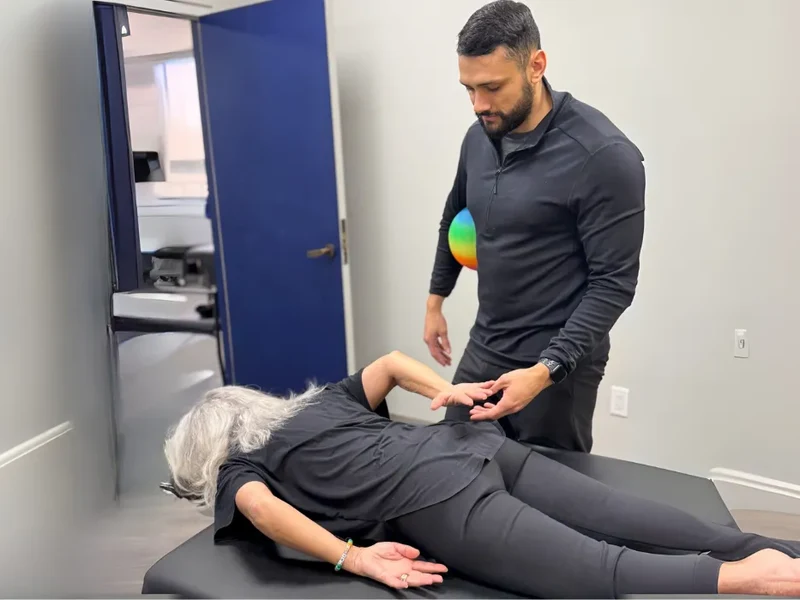
The other missed piece is what is behind the elbow. Grip strength depends on the shoulder and scapula holding a stable base, and forearm tendons work much harder when the shoulder is weak, the neck is contributing, or the wrist has lost mobility. We assess the arm as a chain, because treating the sore spot alone is why it keeps coming back.
How arm pain usually shows up.
Where it hurts narrows it down. What makes it hurt tells us the mechanism.
Pain gripping or lifting
A kettle, a briefcase, a racquet or a drill provokes a sharp point of pain at the elbow or wrist.
A grip that fades
Strength drops off through the day, and by evening you are using two hands for one-hand jobs.
Worse the morning after
The activity felt fine. The next morning the arm is stiff, tender and slow to warm up.
Stiffness and lost motion
Turning a key, a doorknob or your palm upward no longer goes all the way without complaint.
Swelling or a tender point
A specific spot you can put a finger on, sometimes with visible puffiness after use.
Numbness or tingling
Pins and needles or dead patches, which point to a nerve and change the plan entirely.
How we treat elbow, wrist and hand pain.
First we identify what the pain actually is. Tendon, joint, nerve and referred pain from the neck all present in the same neighbourhood and need different treatment. We test grip and pinch, load the suspect tissue, check wrist and elbow mobility, and screen the shoulder and neck. That takes a full session with the therapist who will treat you, which is how the plan ends up specific.
Then we settle it and load it. Manual therapy and soft tissue work for the tendon and the restricted joints, Active Release Technique where the tissue is bound down, and joint mobilization to recover the rotation and extension you have lost. Bracing and activity modification get you through the working week. The centrepiece is progressive tendon loading, including work that loads the tendon as it lengthens, which is what actually rebuilds capacity rather than just calming irritation.
Finally we go after the cause. That means shoulder and scapular strength, wrist mobility, and a real look at the task: the grip size, the desk setup, the tool, the technique on a backhand or a swing. Golfers and racquet players get their mechanics addressed, because the arm will keep losing that argument until the swing changes.
No referral needed in New York for up to 30 days or 10 visits. In network with Medicare and Medicare Advantage, out of network with most other plans, and we submit claims on your behalf. Same-week appointments are usually available at both locations.
Questions about elbow, wrist and hand pain.
01 / Why does this keep coming back every time I stop the brace and go back to work?
02 / Do I need a referral or imaging first?
03 / Should I keep playing or working through it?
04 / How is this billed?
Schedule Your Appointment
No referral needed in New York. Same-week appointments available at both locations.
Your first visit is a full one-on-one evaluation with a licensed physical therapist: come in, tell us everything, and leave with a plan.
You’re all set.
We’ll reach out within one business day to confirm your appointment. If you need to speak with us sooner, call us directly.