

Multiple Sclerosis Physical Therapy in the Hamptons
MS is unpredictable. What you can do with your walking, your strength and your energy is far less unpredictable than most people are led to believe.
MS slows the signal. Most of what you lose after that comes from moving less, and that part answers to training.
In multiple sclerosis the immune system damages the myelin sheath that insulates nerve fibres in the brain and spinal cord. Signals that used to travel fast and clean arrive slower, weaker or scrambled. That is why the symptoms are so varied and why they change: which fibres are affected decides whether you get foot drop, a stiff and spastic leg, poor balance, weakness on one side, or a walking pattern that costs three times the energy it used to.
The energy cost is the piece most people never have explained to them. Fatigue in MS is partly the disease itself, and partly the fact that inefficient movement is expensive. A leg that drags, a hip that hitches, a trunk that works to keep you upright: all of it burns energy you do not have to spare. Improve the efficiency of the walking and the strength that supports it, and the fatigue budget stretches further. Heat matters too, because a rise in core temperature slows conduction in damaged nerve fibres further, which is why symptoms can flare in a hot room or late in a workout and then settle again once you cool down.
Physical therapy does not change the disease process. It changes the strength, the mobility, the balance and the efficiency you have to work with, and it does so without frying your energy or overheating you, which is exactly what a general exercise class cannot manage.
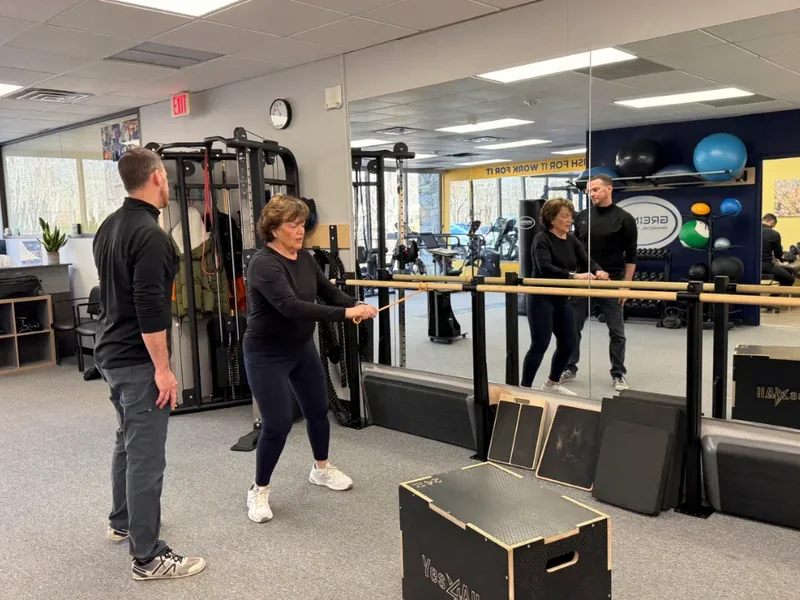
What we treat in MS.
Bring your whole pattern, including the good days, because the plan is built around your variability.
Fatigue that arrives out of proportion
A short errand costs you the afternoon, and the cost is worse late in the day or in the heat.
Walking that has changed
A shorter step, a wider base, a foot that catches or drags, or a leg you have to swing around.
Stiffness and spasticity
Legs that feel tight and resistant, sometimes with spasms, worst first thing or after sitting still.
Balance and dizziness
Unsteadiness turning, in the dark, on uneven ground, or when you move your head while walking.
Heat sensitivity
Symptoms worsen in a hot room, a hot shower or a hard effort, then settle once you cool down.
Weakness, numbness and clumsiness
One side that will not hold up, patches of numbness, and hands that drop things they used to hold.
How we treat MS as physical therapy.
This is a physical therapy practice, so this page is about physical therapy. We assess your walking in detail: speed, step length, symmetry, what happens as you tire, whether the ankle clears the ground, and whether your current brace or device is helping. We test strength, spasticity and range, balance in progressively harder conditions, and your tolerance to exertion and to heat. Then we build a plan around your actual pattern, including how much you have on the good days and what happens on the bad ones.
Treatment covers gait and foot clearance work with the right bracing or device, hands-on and positioning work plus a stretching program for spasticity and range, progressive strengthening in the sequence that most improves walking, balance and postural retraining, and conditioning built in short intervals with real rest so the session improves your capacity instead of spending it. We keep the room and the workload on the cool side, watch for the signs that heat is affecting you, and stop before a session costs you the next two days.
Our neurological background here is genuine. We run neurological rehab and balance therapy, our owner is head coach of Rock Steady Boxing Hampton Bays for the Parkinson’s community, and a member of our treating team trained through neurological rotations. That matters for MS, because managing a progressive neurological condition takes a therapist who knows how to progress carefully, hold ground during a relapse, and pick the work back up afterward.
No referral needed in New York for up to 30 days or 10 visits. In network with Medicare and Medicare Advantage, out of network with most other plans, and we submit claims on your behalf. Same-week appointments are usually available at both locations.
Questions about multiple sclerosis.
01 / Will exercise make my MS worse or trigger a relapse?
02 / Why does the heat affect me so much?
03 / Do you provide occupational therapy or speech therapy too?
04 / Do I need a referral, and how does insurance work?
Schedule Your Appointment
No referral needed in New York. Same-week appointments available at both locations.
Your first visit is a full one-on-one evaluation with a licensed physical therapist: come in, tell us everything, and leave with a plan.
You’re all set.
We’ll reach out within one business day to confirm your appointment. If you need to speak with us sooner, call us directly.