

Stroke Rehabilitation in the Hamptons
Inpatient care ends, home care ends, and then most families are left with a home exercise sheet and no idea how hard to push. This is the phase where outpatient stroke rehab earns its keep.
A stroke damaged the route, not the destination.
A stroke interrupts blood supply to part of the brain, and the cells that die take their connections with them. The muscles on the affected side are usually intact. What is missing is the pathway that recruits them properly, which is why the limb feels foreign rather than sore, and why willpower on its own does not get it back.
Brains reorganise, though, and they do it in response to practice. Not to any amount of talking, and not to gentle range of motion. To a high number of repetitions of a specific, difficult, meaningful task with somebody skilled adjusting the difficulty as you go. The two things that most reliably limit outcomes after a stroke are dose and difficulty: not enough repetitions, and repetitions too easy to force a change. Both are fixable, and both need a therapist in the room for the whole session.
The other thing worth saying plainly, because families are rarely told it: the window for improving strength, walking and balance is much wider than the window for spontaneous neurological recovery. Being a year or three out is not a reason to stop. It is a reason to ask whether the work was ever hard enough.
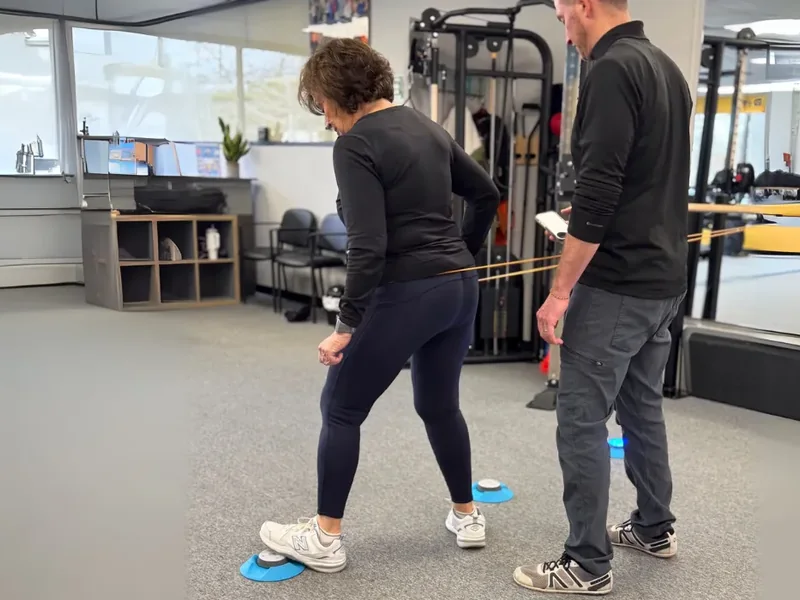
What outpatient stroke rehab works on.
Bring the ones that are limiting the day, not just the ones on the discharge paperwork.
Weakness on one side
Hemiparesis that makes an arm or leg unreliable, and that fatigues far faster than the other side.
A changed walk
Circling the leg through, a foot that drops or catches, no push-off, and a stride that is quietly asymmetrical.
Balance and fear of falling
Turning, reaching, standing on uneven ground or moving in low light have all become deliberate acts.
Spasticity and tone
A limb that grips into a pattern when you try to move quickly, tightening further with effort or fatigue.
Endurance that ran out
Ten minutes of walking used to be nothing. Now it costs the rest of the afternoon.
Progress that stopped
Improvement stalled when formal therapy ended, which is very often a dosing problem rather than a hard ceiling.
Repetitions that are hard enough to change something.
We start by measuring the tasks that matter: how you stand up, how you walk and how far, what happens on a turn or a kerb, how balance holds when we take away a reference, and where safety is actually at risk in your home. One of our licensed physical therapists trained through subacute rehabilitation and outpatient neurological rotations, which is where the emphasis on measured, task-specific practice in this program comes from.
Treatment is gait retraining with real intent, from step length and push-off to turning and stairs, balance and reaction training under genuine challenge, progressive strengthening of the affected side, endurance so you get your day back, and task-specific practice of the things you have stopped doing. Manual therapy and positioning help with tone and the stiff, painful shoulder or ankle that often comes with hemiparesis. To be clear about scope: we are physical therapists, so we do not provide speech therapy, swallowing therapy or occupational therapy, and we will coordinate with the providers who do.
No referral needed in New York for up to 30 days or 10 visits. In network with Medicare and Medicare Advantage, out of network with most other plans, and we submit claims on your behalf. Same-week appointments are usually available at both locations.
Questions about stroke.
01 / Do we need a referral to start outpatient physical therapy after a stroke?
02 / Is this covered by Medicare?
03 / It has been two years since the stroke. Is there any point?
04 / Do you offer speech therapy or occupational therapy?
What our patients say.
"Greiner is absolutely the best. There is no comparison. All highly trained DPTs, they work hard to identify your specific needs and then to engage and motivate you to heal."Joanna B. · Google review
Schedule Your Appointment
No referral needed in New York. Same-week appointments available at both locations.
Your first visit is a full one-on-one evaluation with a licensed physical therapist: come in, tell us everything, and leave with a plan.
You’re all set.
We’ll reach out within one business day to confirm your appointment. If you need to speak with us sooner, call us directly.