

Carpal Tunnel Syndrome Treatment in Speonk, NY
The hand wakes you at two in the morning and you shake it out until it settles. That is a nerve asking for room, and physical therapy is often how it gets some.
Your hand is not the problem. A nerve is running out of space on the way there.
The median nerve travels down the forearm and passes through a narrow tunnel at the wrist, sharing that space with nine tendons. Pressure inside the tunnel rises the moment the wrist bends far in either direction, and it rises further with sustained gripping, vibration, or hours of the same motion. When pressure stays high long enough, the nerve stops carrying signal properly. That is the numbness, the tingling, the clumsy pinch, the thumb muscle that has quietly got smaller.
It wakes you at night for a mechanical reason: most people sleep with the wrist curled, which is the position of highest pressure. So it builds for hours, you shake the hand out, the pressure drops, and it settles. That is also why a splint that holds the wrist straight overnight is one of the most useful things you can do in week one.
Two other things get missed. The nerve can be irritated at more than one place along its route, so a stiff neck or a tight forearm can make the wrist far less tolerant than it otherwise would be. And the tunnel is affected by things outside your wrist, including thyroid function, diabetes, rheumatoid arthritis, and hormonal change during pregnancy or menopause. We look up the arm and at the whole picture, not just at the wrist.
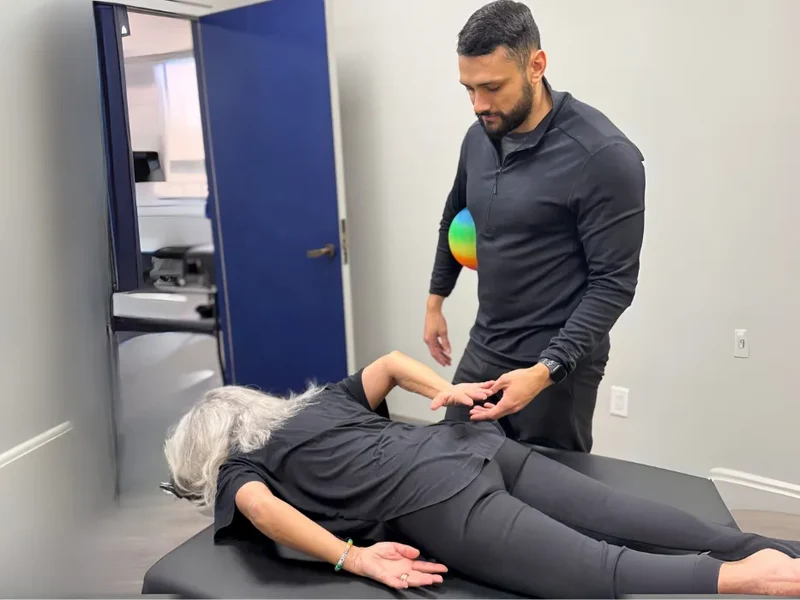
What median nerve compression feels like.
The distribution matters as much as the sensation, because it tells us which nerve is involved.
Numbness in the thumb side of the hand
Thumb, index, middle and half the ring finger. The little finger is usually spared, which is a useful clue.
It wakes you at night
Burning or tingling in the small hours, relieved by hanging the hand down or shaking it out.
Pins and needles with activity
Driving, holding a phone, typing, a bike handlebar, or a golf grip sets it off within minutes.
A grip that is losing power
Jar lids, buttons and keys have got harder, and you drop things you thought you had hold of.
Clumsiness with small objects
The fingers feel padded, so fine tasks take more attention than they used to.
Aching that creeps up the forearm
Pain that does not stay in the hand and refers up toward the elbow after a long day.
How we treat carpal tunnel syndrome as physical therapy.
The evaluation tests the nerve rather than guessing at it. We check sensation and strength in the median nerve distribution, load the tunnel to see what reproduces your symptoms, and screen the neck, first rib and forearm for a second site of irritation. Grip and pinch get measured so we have a number to progress against.
Treatment has three parts. First, take the pressure off: hands-on work to the carpal bones, forearm and wrist flexors, Active Release Technique where the tissue is bound down, and a neutral wrist splint worn at night while the nerve calms. Second, restore the nerve gliding and tendon gliding that pressure has cost you, in small graded doses, because a nerve responds badly to being stretched hard. Third, remove the load that caused it: the keyboard and mouse height, the tool grip, the steering wheel, the way you hold a club or a paddle, and the shoulder and scapular strength that lets the arm work without the wrist bracing.
Some hands need a surgeon, and we will say so. Muscle wasting at the base of the thumb, constant numbness that no longer comes and goes, or symptoms that will not budge are reasons to get a nerve conduction study and a hand surgeon opinion. We coordinate that rather than quietly keep treating you.
No referral needed in New York for up to 30 days or 10 visits. In network with Medicare and Medicare Advantage, out of network with most other plans, and we submit claims on your behalf. Same-week appointments are usually available at both locations.
Questions about carpal tunnel syndrome.
01 / Do I need a referral, and do I need a nerve test first?
02 / Can physical therapy prevent carpal tunnel surgery?
03 / Does the night splint actually help?
04 / How does insurance and cost work?
Schedule Your Appointment
No referral needed in New York. Same-week appointments available at both locations.
Your first visit is a full one-on-one evaluation with a licensed physical therapist: come in, tell us everything, and leave with a plan.
You’re all set.
We’ll reach out within one business day to confirm your appointment. If you need to speak with us sooner, call us directly.