

Thoracic Outlet Syndrome Treatment in Speonk, NY
You have been told it is carpal tunnel, then a disc, then stress. Thoracic outlet syndrome is one of the most commonly missed sources of arm symptoms, and it responds well to the right hands-on work.
A crowded corridor between your collarbone and your first rib.
Every nerve and blood vessel serving your arm leaves the neck through a narrow corridor, passing between the scalene muscles, over the first rib and under the collarbone, then beneath the pec minor. It is tight by design. Anything that makes it tighter, an elevated first rib, scalenes that never switch off, a shoulder blade sitting forward and down, a tight pec minor, or in some people an extra cervical rib, starts crowding the brachial plexus and the subclavian vessels that share the space.
Two contributors do most of the quiet work here, and both are addressable. Posture, where a rounded, forward shoulder position and a forward head narrow the corridor and shorten the scalenes and pec minor. And breathing pattern, which almost nobody screens. If you breathe with your upper chest rather than your diaphragm, the scalenes and the muscles that lift the first rib are working thousands of times a day. They hold that rib high, and the corridor never gets a chance to open.
It is also worth knowing there are three versions. Neurogenic, the common one, where the nerves are compressed and you get numbness, tingling, aching and weakness. Vascular, where the vessels are involved and the hand may be cold, pale, bluish or swollen. And nonspecific, where symptoms fit the pattern without clean nerve or vessel findings. They need different handling, so identifying which one you have is part of the first visit rather than an afterthought.
The pattern that keeps getting misdiagnosed.
TOS mimics carpal tunnel, cubital tunnel, a cervical disc and a rotator cuff problem, which is why it is so often missed.
Numbness and tingling in the hand
Often along the inner forearm and the little and ring fingers, and often in the whole hand rather than one nerve’s territory.
Worse with your arms overhead
Hanging laundry, washing hair, reaching into an overhead bin or driving with hands high sets it off within a minute or two.
Arm heaviness and fatigue
A dead, tired arm after ordinary use, with grip that fades rather than a single sharp weakness.
Neck, collarbone and upper chest ache
A deep ache around the base of the neck, above the collarbone and into the front of the shoulder.
Worse at night and in the car
Sleeping with the arm overhead, or long drives, both hold the corridor in its narrowest position for hours.
Colour, temperature or swelling changes
A hand that turns pale, bluish, cold or puffy suggests vascular involvement and needs medical assessment promptly.
Open the corridor, change the breathing, restore the nerve’s glide.
The examination is the part most TOS patients have never had. We test how position changes your symptoms, screen the neck and the nerve at the wrist and elbow so we are not treating the wrong site, assess first rib and thoracic mobility, check scalene and pec minor length, look at how your shoulder blade sits and moves, and watch you breathe. That last one is not a formality. In a lot of these patients it is the finding that explains everything.
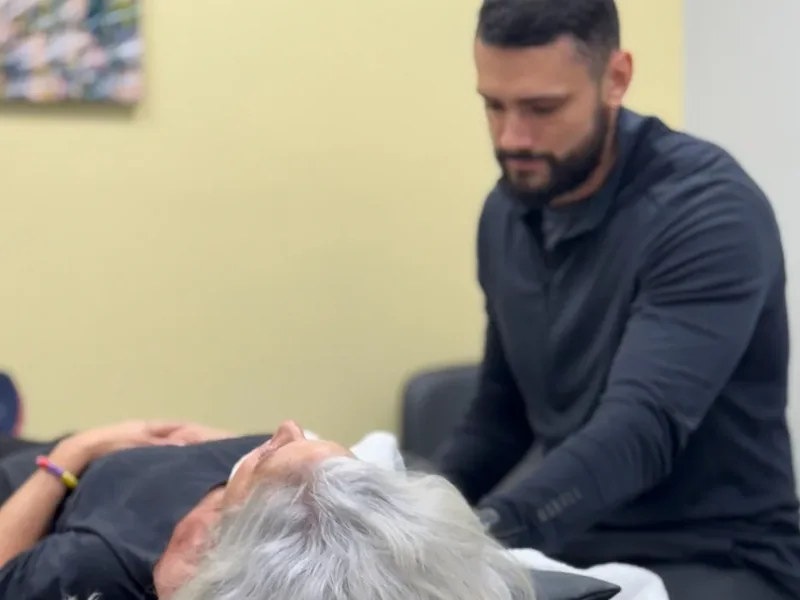
Treatment is skilled hands-on work plus specific retraining. First rib and thoracic mobilisation to open the space, soft tissue release of the scalenes and pec minor, including Active Release Technique, and diaphragmatic breathing retraining so those muscles stop hauling the rib upward all day. Then brachial plexus nerve glides to restore the sliding the nerve needs, deep neck flexor and scapular strengthening to hold the corridor open without you thinking about it, and practical changes to sleeping position, desk setup and how you carry a bag. If your presentation is vascular, we will say so and get you to the right physician rather than working around it.
No referral needed in New York for up to 30 days or 10 visits. In network with Medicare and Medicare Advantage, out of network with most other plans, and we submit claims on your behalf. Same-week appointments are usually available at both locations.
Questions about thoracic outlet syndrome.
01 / How do I know this is TOS and not carpal tunnel?
02 / Do I need a referral to be seen, and how does insurance work?
03 / Will I end up needing surgery?
04 / How long does this take?
What our patients say.
"I have gone to PT for the last 15 years at other institutions offering PT. No one compares to Greiner PT."John S. · Google review
Schedule Your Appointment
No referral needed in New York. Same-week appointments available at both locations.
Your first visit is a full one-on-one evaluation with a licensed physical therapist: come in, tell us everything, and leave with a plan.
You’re all set.
We’ll reach out within one business day to confirm your appointment. If you need to speak with us sooner, call us directly.