

Golf Injury Treatment in the Hamptons
The back tightens by the twelfth, the elbow barks on every fat shot, and you have lost twenty yards. We treat the injury and screen the swing that keeps producing it.
Golf injuries are rarely a golf accident. They are a movement limitation the swing has to work around.
A good swing is a sequence: the ground, then the hips, then the trunk, then the arms, then the club, each handing off at the right moment. Take one link out of that chain, a hip that will not rotate, a mid-back that will not turn, a shoulder that has lost overhead motion, and the swing does not stop. It finds another way to deliver the club. That workaround is where the injury comes from, and it is why the same spot hurts every round.
The classic patterns are predictable once you know what to look for. Limited hip and thoracic rotation forces the lower back to supply the turn, so it takes the side-bending and rotation load. Casting the club early, or losing your posture, puts the wrists and elbows in charge of squaring the face, which is how the forearm tendons get overloaded. A sway or a reverse pivot moves the low point of the swing, so you hit the ground harder and the hands and lead wrist absorb it.
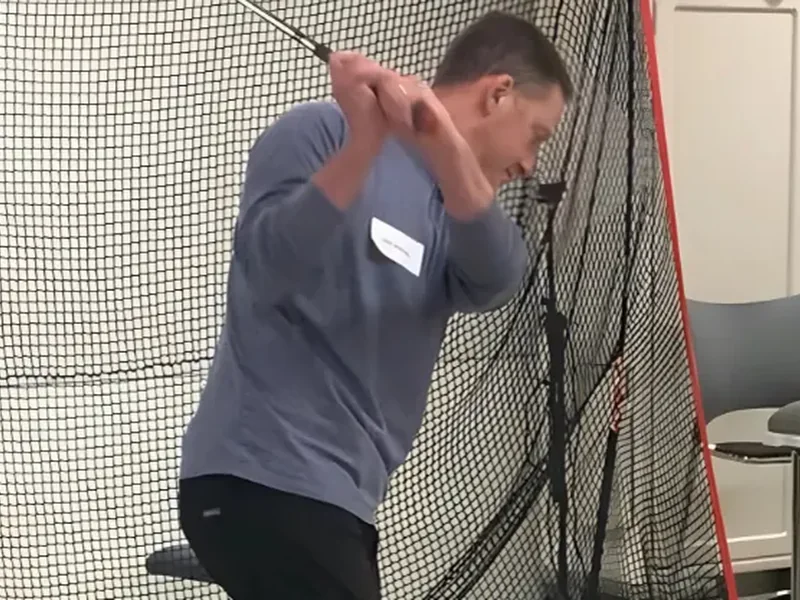
Which is why treating only the sore tissue buys you three weeks. If the limitation stays, the swing keeps making the same compensation on the next hundred balls. We are TPI certified, which means we screen the movement behind the swing and then treat both.
What golfers actually come in with.
Distance loss belongs on this list. It is usually a movement restriction talking, not age.
Low back pain that builds through the round
Fine on the range, tight by the twelfth, sore that night and stiff on the range mat the next morning.
Elbow or lead wrist pain
Pain on impact, worse from a fat shot or a range session, and now noticeable lifting a coffee cup.
Shoulder pain at the top or through impact
A pinch at the top of the backswing, or a lead shoulder that aches through the follow-through.
Rotation you no longer have
You cannot turn as far as you used to, so the arms take over and the sequence falls apart.
Hip or knee pain on the turn
Torque through the trail hip or lead knee, especially walking eighteen on a hilly course.
Lost clubhead speed
Distance has quietly gone, which is often mobility and sequencing rather than strength or age.
How we treat golf injuries, and the swing behind them.
We treat the injury like an injury. Hands-on work to the restricted joints and irritated tissue, Active Release Technique where the tissue is bound down, spinal and hip mobilization to get rotation back, and graded loading for whatever tendon has been carrying the extra work. That part gets you comfortable.
Then we look at why it happened. Our TPI certified golf assessment runs 90 minutes and includes the 16-movement screen, video capture of your swing and launch monitor data, so the limitation, the swing fault and the ball flight all get looked at together rather than one at a time. You get a reassessment at six weeks to confirm what changed, in both your movement and your numbers.
From there the work is specific: mobility where you are restricted, stability where you are leaking energy, and strength and speed work, including SuperSpeed Golf training, to put the distance back once the pattern is safe. If your priority is performance rather than pain, that is a different starting point, and our golf performance page is where to begin.
No referral needed in New York for up to 30 days or 10 visits. In network with Medicare and Medicare Advantage, out of network with most other plans, and we submit claims on your behalf. Same-week appointments are usually available at both locations.
Questions about golfing injuries.
01 / Do I have to stop playing while I get treated?
02 / What is in the TPI golf assessment?
03 / Do I need a referral, and how does insurance work?
04 / Can this help me hit it further, or is it only for injuries?
Schedule Your Appointment
No referral needed in New York. Same-week appointments available at both locations.
Your first visit is a full one-on-one evaluation with a licensed physical therapist: come in, tell us everything, and leave with a plan.
You’re all set.
We’ll reach out within one business day to confirm your appointment. If you need to speak with us sooner, call us directly.