

Hip Replacement Rehab in Speonk, NY
The surgeon replaced the joint. Nobody replaced the muscles that have been avoiding it for years. That gap is why people limp long after the hip stopped hurting.
Book Your First Visit
No referral needed in New York · Same-week appointments at Speonk and Quogue.
You’re all set.
We’ll reach out within one business day to confirm your appointment. If you need to speak with us sooner, call us directly.
A new hip is hardware. Walking without a limp is a skill, and it has to be retrained.
The operation solves the joint. It does not solve what happened around the joint in the years before it, and that is the part patients are surprised by. By the time most people reach surgery they have spent a long time protecting that side: the gluteal muscles have got weak, the hip has lost extension and rotation, the other leg has been quietly doing extra, and the walking pattern has been rebuilt around avoiding pain. All of that survives the operation intact.
Then there is the surgery itself. Soft tissue was cut and moved to get to the joint, so swelling, guarding and weakness are real for weeks. Depending on the surgical approach, your surgeon may give you hip precautions, positions to avoid while the tissue around the new joint heals so the prosthesis stays where it belongs. Knowing your approach and your precautions changes what we do and do not do in the early weeks.
So the job here is specific: respect the precautions, rebuild the gluteal and leg strength that has been missing for years, and retrain walking on purpose. Otherwise the limp becomes permanent, the other leg and the low back take the difference, and the fall risk stays up long after the hip itself is comfortable.
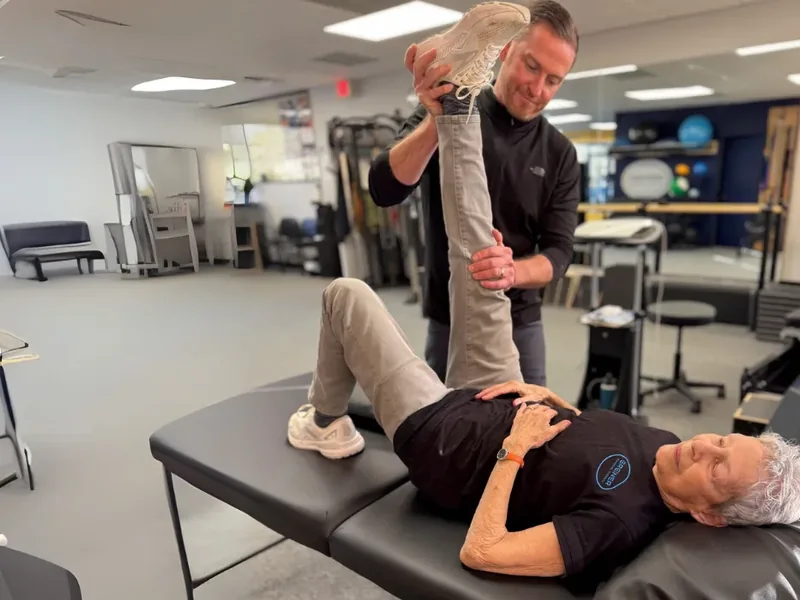
What we treat after a hip replacement.
Some patients come to us the week they get home. Others come years later because the limp never left.
Swelling, guarding and post-op pain
A tight, full, sore hip that limits how much motion you are willing to ask of it.
A limp that has become habit
You lurch to the operated side or hitch the hip, often without knowing you are doing it.
Weakness on the side of the hip
The gluteal muscles that keep your pelvis level have been off duty a long time, and it shows on one leg.
Stiffness reaching, bending and dressing
Socks, shoes and getting in and out of a car are all harder than the hip itself now feels.
Stairs, curbs and uneven ground
You lead with the good leg every time, and gravel drives and lawns still feel like a risk.
Fear of the new joint
A reasonable caution about dislocation and about falling, which quietly keeps you doing less than you could.
How we rehab a hip replacement.
We start by reading your surgery, not just your hip. Which approach was used, what precautions your surgeon set, what weight-bearing status you have, and where you are with swelling and wound healing. Then we measure the things that will actually decide your outcome: hip range, gluteal and quadriceps strength, how you rise from a chair, how you walk with and without a device, and what you can do on one leg.
Early sessions clear swelling and restore comfortable motion within your precautions, teach safe transfers in and out of a bed, a chair and a car, and get you moving with the right assistive device fitted properly. From there the focus is strength: the gluteals, the quadriceps, the hamstrings, the calf and the trunk, progressed each week as the tissue allows. Balance work runs alongside it, because fall risk after a hip replacement is a real thing and it is trainable.
The last phase is the one most programs never get to. Walking retrained deliberately, at normal speed, with a normal step length and no hitch. Stairs without leading, in both directions. Getting off the floor. Grass, gravel, ramps and sand. Then back to the thing you actually stopped doing, whether that is eighteen holes, a boat, or two hours in a garden. If getting to the clinic is the barrier in the early weeks, we can come to you.
No referral needed in New York for up to 30 days or 10 visits. In network with Medicare and Medicare Advantage, out of network with most other plans, and we submit claims on your behalf. Same-week appointments are usually available at both locations.
Questions about hip replacement rehab.
01 / When should I start physical therapy after a hip replacement?
02 / Do I need a referral, and is this covered?
03 / How often will I need to come in, and for how long?
What our patients say.
"I had hip replacement surgery on 7/14 and started PT around 7/31. All the Physical Therapists were very professional, knowledgeable and very encouraging!"Ted B. · Hip replacement recovery
Schedule Your Appointment
No referral needed in New York. Same-week appointments available at both locations.
Your first visit is a full one-on-one evaluation with a licensed physical therapist: come in, tell us everything, and leave with a plan.
You’re all set.
We’ll reach out within one business day to confirm your appointment. If you need to speak with us sooner, call us directly.