

Weightlifting Rehab in Quogue, NY
For the lifter who got hurt lifting. Rest is not the treatment. We work out what failed, keep you training around it, and rebuild the pattern until the bar is back where it was.
Six weeks off does not fix a pattern. It just makes you weaker while it heals.
Most lifters have already been told to stop lifting. It half works: the tissue calms down, you come back, and within a month the same shoulder or the same low back speaks up again, because nothing about the reason changed. Meanwhile you lost strength and muscle you now have to rebuild, and the layoff did not make the pattern any better.
We work the other way. First we find what actually failed, which is usually not the tissue that hurts: a hip that will not hinge, a shoulder without the overhead range it is being asked for, a brace that lets go at the bottom of the squat, a bar path that drifts under fatigue. Then we keep you training around it, because loaded movement is what tissue heals into. Modified lifts, adjusted ranges, lighter loads used for technique, and blood flow restriction training when we need strength gains in a limb that cannot tolerate heavy weight yet.
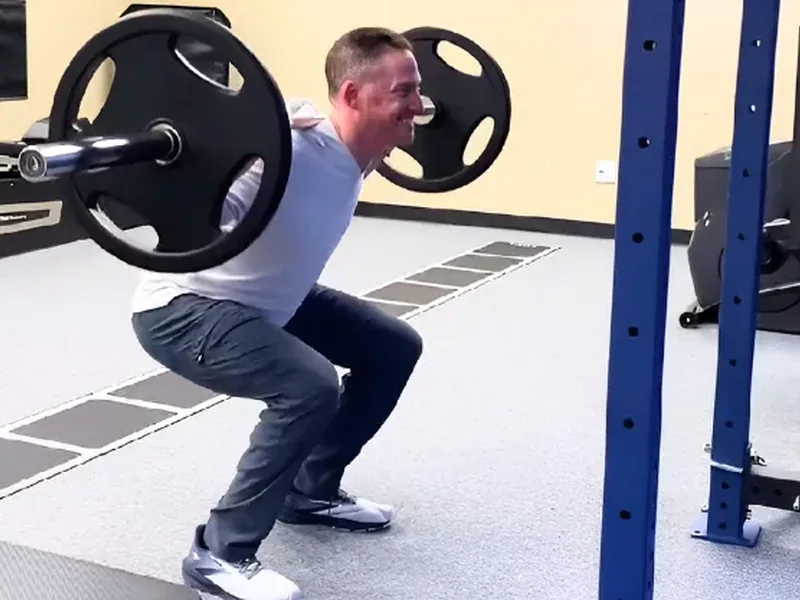
Alongside that, hands-on treatment where the tissue needs it, including Active Release Technique, and real form work: your lifts filmed and corrected, coached on the gym floor at our Speonk clinic rather than described to you on a table. The exit point is not "pain free", it is back to your program at your loads with the fault addressed.
Who we treat.
Lifters, from first year to competitive, and the injuries that come with the sport.
Low back in the deadlift or squat
The single most common lifting complaint we see. Usually a hinge, a brace or a bar path problem, not a broken back.
Shoulders in pressing
Bench and overhead pain, rotator cuff irritation, and the overhead range the lift needs and you do not have.
Knees and hips
Pain in the squat, hip impingement at depth, and tendon irritation that got worse the week you added volume.
Elbows and wrists
Tendinitis from pressing volume, grip and wrist pain, and the pull-up and row injuries nobody warns you about.
Post-surgical lifters
Shoulder or knee surgery behind you and a bar in front of you. This is the bridge between discharge and your old program.
The injury that keeps returning
Same spot, every training block. That is a pattern problem, and patterns can be retrained.
What you get out of it.
The goal is your program at your loads, not a discharge note.
Strength you did not lose
Training continues in a modified form throughout, so you are not rebuilding from zero when the pain resolves.
The cause, identified
The mechanical reason the injury happened, named, and addressed. That is what stops the annual repeat.
Technique that holds under load
Filmed, reviewed and coached on the gym floor, at weights that are real rather than demonstration singles.
A full return to loading
A plan back to your working weights, with criteria rather than a calendar deciding each step.
A therapist who lifts
Staff who understand a training block, a competition date and why "just stop lifting" is not an acceptable plan.
Tune-up rules
What to monitor and when to come back in, so the next heavy block does not end the way this one did.
Questions about weightlifting rehab.
01 / Do I need a referral, and how does insurance work?
02 / Can I keep lifting while I rehab?
03 / How long does it take?
04 / How is this different from weight lifting analysis?
What our patients say.
"After 6 months of him and his teammate Anthony I am feeling confident to go on with my life. I am able to run without pain."Greiner patient · Return to running
Schedule Your Appointment
No referral needed in New York. Same-week appointments available at both locations.
Your first visit is a full one-on-one evaluation with a licensed physical therapist: come in, tell us everything, and leave with a plan.
You’re all set.
We’ll reach out within one business day to confirm your appointment. If you need to speak with us sooner, call us directly.